This blog is my main on-line filing cabinet, open to the world. It focuses on interactive multimedia technology that supports collaboration, communication, creativity, and learning. Topics include multi-touch, touch and gesture interaction, HCI, UX, ID, IA, NUI (natural user interfaces/ natural user interaction), interactive displays/surfaces, mobile technologies, 3D, universal usability/accessibility, and interactive multimedia content in a 2.0/3.0 world.
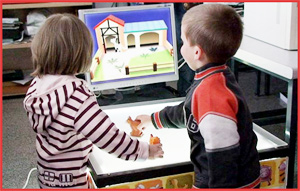
NIKVision is an interactive tangible tabletop designed for young children, but suitable for "kids" of all ages. Javier Marco Rubio shared his team's work on the NIKVision system on the TechSpark website, and I thought I'd share some of the videos on this post. What I like about NIKVision is that the team encouraged the participation of children as design partners, which is a very special approach.
"NIKVision is a Tangible tabletop in which toys control the games. NIKVision has been created by Javier MMarco, from GIG Group in University of Zaragoza, Spain." http://webdiis.unizar.es/~jmarco
Researchers for this project included Javier Marco, Eva Cerezo, and Sandra Baldassarri.
Here is a link to the post on The World Is My Interactive Interface blog - the post includes video clips and links to additional information from Cisco:
I'm wrapping up an interesting post about stereoscopic 3D, including wisdom from the "3D Guy", my impressions of the 3D displays and 3D glasses I tried out during a recent trip to Best Buy, and information about NVIDIA's recent developments in the area of stereoscopic 3D gaming. The post will be on the Interactive Interactivity blog soon. (I'll share the post, along with additional "behind the scenes" info later this week, on this blog.)
This is a fast-moving topic!
If you are new to this blog, here are links to my previous posts about stereoscopic 3D:
If you are interested in looking for a job or an internship involving multimedia, take a look at the 20 opportunities highlighted on the Interactive Interactivity blog. This list is featured monthly.
"In the second decade, people will not search for new technologies allowing for even easier, faster and low-priced content production. Rather, appropriate reactions to this media revolution are to be developed and integrated politically, culturally and socially. The concept “Slow”, as in “Slow Food” and not as in “Slow Down”, is a key for this. Like “Slow Food”, Slow Media are not about fast consumption but about choosing the ingredients mindfully and preparing them in a concentrated manner. Slow Media are welcoming and hospitable. They like to share." -Slow Media Manifesto
I especially liked #5 of the Slow Media Manifesto:
"5. Slow Media advance Prosumers, i.e. people who actively define what and how they want to consume and produce. In Slow Media, the active Prosumer, inspired by his media usage to develop new ideas and take action, replaces the passive consumer. This may be shown by marginals in a book or animated discussion about a record with friends. Slow Media inspire, continuously affect the users’ thoughts and actions and are still perceptible years later. "
I'm putting together information for my next post about the evolution of 3D technologies and thought I'd go ahead and share this press release about 3D video streaming. I'd love to see this in action!
The beauty of this news is that NVIDIA has worked in collaboration with Microsoft to develop streaming content using Silverlight and IIS Smooth Streaming so people can watch stereoscopic 3D content from their PC's.
COMPUTEX 2010—TAIPEI—May 31, 2010—NVIDIA today demonstrated 3D video streamed live over the Internet using an NVIDIA® 3D VisionTM PC, Microsoft Silverlight and IIS Smooth Streaming technology. The demonstration, which streamed the music video “We Are the World” 3D, at a press conference at Computex, comes at a time when consumer interest in seeing 3D movies is at its highest level ever.
“We’ve been collaborating with Microsoft to enable 3D in an Internet browser so that it’s very simple to use,” said Phil Eisler, General Manager of 3D Vision technology at NVIDIA. “Just click on a 3D video and it plays in 3D, using the latest 3D Vision Silverlight-based video player and NVIDIA 3D Vision. Internet users can now enjoy 3D video content streamed in high-definition (HD) quality and viewed at full resolution. This is another great benefit of having a 3D PC.”
To take advantage of this technology, consumers will need an NVIDIA 3D Vision-based desktop or notebook PC equipped with the latest 3D Vision drivers and the Silverlight browser plug-in. Once these are installed, consumers can then navigate to any Web site hosting 3D Vision-based content.
For content owners, this milestone provides a secure path to distribute and monetize 3D video over the Web with Silverlight and IIS Smooth Streaming. Movies, trailers, sports and any form of 3D video can now be hosted and streamed over the Internet to a growing market of 3D PCs, most of which ship with Windows 7.
“Customers have a peaked interest in 3D entertainment experiences, and Microsoft is looking forward to working with NVIDIA to bring these experiences to users through their PCs,” said Scott Guthrie, corporate vice president of the .NET Developer Division at Microsoft Corp. “Silverlight and IIS Smooth Streaming together deliver the highest quality HD video experiences over the Web and, with NVIDIA 3D Vision, will now provide consumers with a way to watch their favorite movies, sporting events, music videos and more, all in 3D from their own computer.”
For more information on how to use and install 3D streaming capabilities on 3D Vision PCs visit http://www.nvidia.com/get3D
I was fortunate to see some of these interaction techniques and interfaces when I attended CHI 2010 this past April, and plan to share some of my photos and video clips from the conference on this blog soon.
Totally Unrelated
Online connection for foodies
Eatocracy is a new website within the CNN pages that provides news- and more- about all things related to food. The categories on the site include "main", "news", "bite", "sip", "make", "think", and "buzz". The best part, in my opinion, is the heirloom recipe collection index, where people can upload and share family recipies and the stories behind them.
Here is the description of Eatocracy from the website:
Eatocracy "is your online home for smart, passionate conversation and information about food news, politics, culture. We'll highlight regional and family recipes, dive into restaurants and food shopping, chat with celebrity and local chefs, and show you what's for dinner around the world tonight. Grab a place at the table and read with your mouth full."
As I took a peek at Lieven's video links, I noticed an interesting video mash-up Lieven created from the open-source code from the RadioHead's House of Cards music video and his One Million Particles app. I'll post them soon.
I'll try to get video, pictures, and commentary about EVA 2010. EVA stands for Electronic Visualization and the Arts. "Electronic Information, the Visual Arts, and Beyond.
FYI
I'm in the process of sorting through and re-organizing my blogs, which have been around for over four years! During this time, my blogs have attracted a growing number of readers. Because of this, I'd like to make things a bit user-centered. So expect to see little changes here and there. I promise I'll give my readers warnings in advance if I make any serious changes!
If you are new to this blog, you should know that my blogs started out as on-line filing cabinets, open to the world. Although there is a bit of overlap of material and some cross-posting between the blogs, they are arranged to serve as a paper-less way of keeping track of things that I've learned through my coursework, conference attendance, readings, and research. Since emerging technologies are high on my list of interests, I also use my blogs to share interesting things that cross my path.
I changed the name of my World Is My Interface blog to The World Is My Interactive Interface."Off-the-desktop natural user interfaces, interaction, and user experience" are the main topics of the blog. It sometimes includes information about ubiquitous computing and DOOH, otherwise known as Digital Out Of Home.
I plan to tinker with my TechPsych blog later on. It focuses on topics that are useful to psychologists, educators, special education teachers, speech and language therapists, health and wellness professionals, and parents.
Feel free to leave comments, as I welcome your input.
I came across the following video and link when I visited Jonathan Brill's Multi-touch Maven blog. The multi-touch project was developed as part of the Patric Baudisch's Human Computer Interaction Research class at the Hasso Plattner Institute.
Detailed directions, along with pictures, can be found on the Designer Multi-touch Padwebsite. From there, you can download the OpenCV source code, which requires Microsoft's Visual Studio, from the project's website, along with a copy of the how-to video, a nice shopping list, and references.
-Hasso Plattner Institut
This is what graduate students and post-docs play with!
The following information is from the CCC/CRA Roadmapping for Interactive Technologies website, describing an upcoming series of three three-day workshops that I think have the potential for changing the way interactive technology is designed and implemented in the future:
"The modern computing experience is shaped by the ways in which people interact with their computers. Underlying that interaction are the technologies of input, sensing, interactive techniques and interactive architecture. This is a series of workshops that will create a research agenda for revolutionizing these foundational technologies."
The last few decades have produced many new interactive technologies and many interactive techniques. Few of them are making their way into actual use because they are so hard to integrate. This workshop will create an agenda for new architectures for building interactive systems that integrate basic interaction in powerful new ways and provide new opportunities and foundations on which to build usable systems.
A culture is defined by its shared stories and the messages that people communicate with each other. Computing has created new ways for stories to be told in entertainment and education. This workshop will outline how we can bring digital storytelling from the realm of multimillion dollar productions down to the practical needs of everyday social, educational and political discourse.
A byproduct of the Internet's success is that large numbers of people can interact with each other and with large stores of loosely interconnected data. This workshop will create an agenda for interactions that involve thousands of participants.
NOTE: Organizers for the Interactive System Architecture Workshop include Dan Olsen, from Brigham Young University, Andy Wilson, from Microsoft Research, and Celine Latulipe, from the University of North Carolina-Charlotte. (Dr. Latulipe was my HCI professor.) Joe Marks is a VP at Disney Research. The organizers for the Ultra-large Scale Interaction Workshop include Mark Ackerman and Mark Newman, from the University of Michigan, Keith Edwards, from Georgia Tech, and Scott Klemmer, from Stanford.
I'd really like to attend all three workshops. I will try to learn all I can about these workshops and share what I find during periodic blog posts over the next several months.
"To keep your adrenaline pumping while waiting for SIGGRAPH to start, here's a few juicy bits of inspiration:
"Simulating Real-world Film Lighting Techniques in 3D. Light, shadows, and rendering play together to create realism in your 3D models. Learn to bring these art techniques into your 3D scenes to create compelling cinematic views."
"Creating UVs for Characters in Autodesk Maya*. Regardless of whether you're using a model in a real-time environment or as part of a rendered sequence, here are some tips and tricks to making UV mapping work efficiently."
Catching up on reading the MIT Technology Review, I came across an article written by Nidhi Subbaraman about the use of graphene to make flexible displays:
The most recent version of graphene was created by researchers in Korea at the Sungkyunkwan University, in collaboration with Samsung. According to the article, graphene was discovered over thirty years ago, but only recently have researchers been able to produce it in large mono-layers. This flexibility looks like it will have possibilities for future display applications, as noted in the video clip below the photos. Photo Credit:Byung Hee Hong, SKKU. Photo Credit: Impact Lab "Future Applications of Graphene"
Today there was an earthquake in Canada on the Ontario-Quebec border region. It was felt around the region, including Michigan. Curious, I took a look at the United States Geological Survey interactive website about earthquakes to learn more: Did You Feel It? The Science Behind the Maps
Here's some info about the earthquake from the USGS website:
"This earthquake occurred near the southern edge of the Western Quebec Seismic Zone. Earthquakes within this zone are mostly small. They tend to cluster in a wide area that is slightly elongated northwest-southeast. Historically, earthquakes in the Western Quebec Seismic Zone have caused damage roughly once a decade. Three or four smaller events each year are felt in the region but are generally too small to cause damage. The largest earthquakes known in this part of Canada occurred in 1935 (M6.1), about 250 km (150 miles) to the northwest of todays event, and in 1732 (M6.2), about 150 km (100 miles) to the east. The 1732 earthquake caused significant damage in Montreal" -USGS
Here are a few videos uploaded to the web regarding the earthquake, which provide the human side of the story:
EARTHQUAKE IN QUEBEC: "I think we DID have one"
For some reason, I like this one. The man is narrating a video clip about the BP spill, pretty boring, and at 1:15 or so, he notices that the ground is shaking. He tells someone in the background to go outside. I like the Canadian accents.
The last time I created an application for a mobile device was about four years ago. It was in the olden days when most of us knew nothing about multi-touch interaction on any size or sort of display. Soon after that, I focused my work on large displays, and tried not to get too distracted by the iPhone when it was introduced.
I can't ignore the iPad, as I think it holds a ton of potential for education and supporting people with special needs.
I can't ignore Android, since I have an Incredible. (I'm tethered to a never-ending family contract with Verizon.)
I have to figure things out during my summer break, right? Brushing up on my "old" coding skills won't move me forward. Soooooo.......
I am searching for the magic solution that will allow the development of applications that allow for smooth interaction across screens of all sizes, from smartphones to huge displays.
Summer is a great time for dreaming and searching, but it is so short. Time-saving advice from my readers would be greatly appreciated! I'm also looking for good information about programming for stereoscopic 3D games for my series of posts about 3D innovations.
The Glass Hammer is an on-line community "designed for women executives in financial services, law, and business." I recently came across the Glass Hammer website when I followed a link to an interesting article written by Melissa J. Anderson, about women in technology. Melissa Anderson, the author of the article, is the associate editor of the Glass Hammer, and is completing a Master's degree at NYU in Media, Culture, and Communication.
Nicki Gilmour, Publisher and Editor-in-Chief, is the woman behind this organization, with a background in the media industry. She is also the CEO of Evolved People Media.
Project Natal was the code name for the Kinect Sensor for Xbox 360. For $149.99 you can pre-order your very-own system from the Microsoft Store that will allow you to interact with video games with your body alone. No need for controllers or 'motes!
Presentation about the fitness benefits of the Kinect Sensor for Xbox 360:
This video is a preview of a dance game for the Xbox using the Kinect Sensor:
It would be great if I could do my Zumba moves with Kinect Sensor system and a great Xbox application!
Here's another video that explains the system in more detail, with brief interviews of innovators from Microsoft:
Here is a copy of my previous post about Project Natal:
How It Works: Microsoft's Project Natal for the Xbox 360 video from Scientific American
Microsoft gathered a wealth of biometric data to recognize the range of human movement in order to develop an algorithm for the next generation of controller-less gaming. "Natal will consist of a depth sensor that uses infrared signals to create a digital 3-D model of a player's body as it moves, a video camera that can pick up fine details such as facial expressions, and a microphone that can identify and locate individual voices."
The technology behind Natal has the potential for a range of uses beyond gaming.
"We used Touch Projector to paint on a multimedia facade (here: Ars Electronica Center, Linz, Austria). Users simply aim their device at the facade causing the viewfinder to show the facade locally. In this local image, users can now draw with the selected color. The building then changes its color accordingly as if users directly painted on it."
Info about the iRiS team members - (will be updated) Johannes Schöning works at the Innovative Retail Laboratory of the German Research Centre for Artificial Intelligence (DFKI) in Saarbruecken. His research interests include new methods and interfaces to intuitively navigate through spatial information, and ways new intelligent interfaces can help people to solve daily tasks more effectively. Johannes recently completed his Ph.D. at the Saarland University. He runs the multi-touch Google group. (LINK: http://groups.google.de/group/multi-touch) Johannes is involved in a range of interesting professional activities. He's currently looking for new opportunities.
Sebastian Boring started his Ph.D. thesis in April 200 6 at Ludwig-Maximilians-Universität München and expectes to graduate July 2010. He's a member of the Fluidum. His research interests include user interfaces for ubiquitous computing and instrumented environments, especially in interaction techniques for multiple devices and displays. He is also interested in 3D computer graphics, 3D modeling and animation, and computer vision. (Sebastian has worked on projects to benefit assisting young people with autism).
Alexander Wiethoff is a passionate interaction designer committed to developing and implementing visionary strategies that support architectural, industrial and interaction design objectives. He works as a researcher in the field of Human-Computer Interaction at the University of Munich. Currently his key research focus is the analysis of design processes in the area of pervasive computing, the creation of work process tools that support communication of multidisciplinary teams and the design of usability testing methods in this domain.
Sorry for the delay in posting this. I've been more than busy lately!
Here is the plug for the mLearnCon conference, currently taking place, June 15-17 2010 in San Diego, CA:
"Join the mLearning vanguard as we explore the potentials (and pitfalls) for mobile learning! mLearnCon is where every aspect of mobile learning including management strategies, platforms (SmartPhones, PDAs, iPods, Tablets, etc), operating systems (Android, BlackBerry, iPhone OS X, Palm, Symbian, Windows Mobile, etc.), authoring tools and technologies, content design & development, and best practices will be explored. Whether you are working in an academic, corporate, government, or military setting ... mLearnCon will give you the ideas, information, and community you and your organization need to succeed."
ESPN 3D officially launches with FIFA World Cup coverage: Live from Bristol
(Ben Drawbaugh, 6/11/10) "As for the tech side of things, ESPN was taking in the 1080i50 side by side 3D signal and converting it to the US-friendly 1080i60 side by side, and since DLP sets expect the checkerboard 3D format, a RealD POD was used to make the link between the cable set-top-box and the TV. The glasses were supplied by XpanD, but not the same universal shutter glasses that we expect to be available at retail soon."
Engdget Interview: Chuck Pagano talks ESPN 3D, mobile streaming
(Darren Murph, 6/12/10) "Chuck stated that ESPN first started taking the whole 3D idea seriously around four years ago, and while the FIFA World Cup feed isn't being shot / directed by ESPN, it's hard to turn down 25 live events in 3D that the entire world will take interest in. He noted that while DirecTV, Comcast and AT&T are signed on at launch, deals are in the works with "all available options" in the US; outside of America, he confessed that the company "isn't looking at anything internationally right now."'
Without fail, the bigger the 3D, the better the illusion. Anything under 50 inches is basically a joke, unless it's your computer monitor or something. And I will say, even though Vizio's XVT Pro television wasn't my favorite experience (it's an LCD and thereby less smooth), the fact that it was 72-inches meant that a plane's wing almost hit me in the nose."