Below is a description of the urban screens concept, the details for potential conference and exhibition partipation, and a section of links and resources related to this topic.
The theme of the conference is "I am here; what can we do?"
"Public screens – or rather large screens situated in public space – are proliferating in cities all over the world. How should we understand the emergence of the electronic screen from the domestic interior onto the streetscape of contemporary cities? What are the implications of the merging of screens with architecture, which turns the surface into a communication resource? How will the overlap between streetscape and datascape shape public space in the future?
– Scott McQuire, “Mobility, cosmopolitanism and public space in the media city” (2009).
"Urban screens are digital displays and visual interfaces situated in urban public spaces. They include LED screens and signs, plasma screens, projections, information terminals as well as intelligent architectural surfaces and media facades. They support the idea of using public space as a platform for creation and cultural exchange, strengthening the local economy and encouraging public interaction and discussion." - Urban Screens Association
Call for Interactive Media And Video Art
The exhibition “I am here; what can we do?” is part of Urban Screens Toronto 2010, an international urban screens conference and exhibition taking place between September 24th-30th 2010; produced in collaboration with the International Urban Screens Association (IUSA).
Urban Screens Toronto 2010 will promote a multifaceted approach to exploring the growing appearance of moving images in urban space and the global transformation of public culture in the context of networked forms of urban screens. It will build on the successful events held in Amsterdam, Manchester, and Melbourne and will be the first international Urban Screens conference held in North America.
Through an integrated program of keynote lectures, panel sessions, workshops, curated screenings and multimedia projects, it will bring together leading Canadian and international artists and curators, architects and urban planners, designers, ad agencies and brand managers, screen operators and content providers, academics, activists, policymakers, technology manufacturers, software developers and more.
I am here; what can we do?
Public Call For:
New or existing experimental, interactive artwork suitable for urban screens.
Short-format video works relevant for presentation on urban screens.
Interactive design & advertising works created for urban screens including past commercial interactive work from advertising agencies and designers.
Student work interactive and video work by students from any institution worldwide.
Themes include, but are not limited to: The meeting point of the real and the virtual; work that incorporates media technology and contemporary building/architectural technology; user-generated content; multi-site, networked projects; work that addresses public spaces and civic engagement.
IMPORTANT INFORMATION:
Submission deadline: MARCH 1 2010
Submission format: Please submit PDF files only, no larger than 3 MB.
Proposals should include:
1) Brief 50-word summary of your artwork
2) Full proposal or description of the project (maximum 2 pages)
3) Maximum 10 images and URL where work can be found online if applicable
4) Documentation of this work if it has previously be exhibited, or of another exhibited work by the artist.
3) Detailed list of technical requirements
4) Curriculum Vitae (maximum 3 pages)
Fees: There is no entry fee. Reasonable presentation fees will be paid, for new and existing interactive work and videos. Fees will not be paid for design & advertising work. Students will not receive a fee, but will be automatically considered for a prize. Please note that we cannot fund the creation of new work.
Submit; In the subject line please write URBAN SCREENS PROPOSAL
Email to JURY at: urbanscreenstoronto@gmail.com
The jury will be comprised of Toronto Urban Screens committee members Michelle Kasprzak, Janine Marchessault, Gabe Sawhney, Suzanne Stein and Sharon Switzer.
Notification: April 1, 2010
RELATED
International Urban Screens Association
Urban Screens Blog
Urban Screens' Resources
Urban Screens '09 Videos "The City as Interface"
Urban Screens' Blogroll
Digital Urban
Infosthetics
Interactive Architecture
Luminapolis
The Mobile City
Urban Projection
Visual Foreign Correspondents
We make money not art
Urban Screens Reader
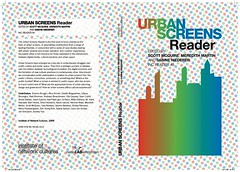
"The Urban Screens Reader is the first book to focus entirely on the topic of urban screens. In assembling contributions from a range of leading theorists, in conjunction with a series of case studies dealing with artists’ projects and screen operators’ and curators’ experiences, the reader offers a rich resource for those interested in the intersections between digital media, cultural practices and urban space."
"Urban Screens have emerged as a key site in contemporary struggles over public culture and public space. They form a strategic junction in debates over the relation between technological innovation, the digital economy, and the formation of new cultural practices in contemporary cities. How should we conceptualize public participation in relation to urban screens? Are ‘the public’ citizens, consumers, producers, or something else? Where is the public located? When a screen is erected in public space, who has access to it and control over it? What are the appropriate forms of urban planning, design and governance? How do urban screens affect cultural experiences?"
FYI:I'm re-visiting all of the above blogs and will share what I find after I surface from the digital rabbit-hole!


