Le Chal is a haptic/vibrational feedback shoe designed for the blind and visually impaired, on of the projects of Anirudh Sharma, a member of the NUI Group (Natural User Interface). Le Chal was conceptualized at the 2011 MIT Media Lab Design and Innovation Workshop at COEP. Take me there Shoe/ Le Chal
To learn more about this project, take a look at the video and related publications below. This is a great example of a team that is harnessing emerging technologies to improve the lives of people with disabilities.
Over the next month or so I will be re-organizing this blog. I'll be analyzing the various themes that have emerged since I started this on 4/11/06, over three years ago, as part of an assignment for a class about distance education and on-line communication tools.
My first topic was "Games, Simulations, and Virtual Worlds". Although I continue to focus on those themes, I mostly center around off-the-desktop interactive, collaborative, and emerging technologies that support interaction and activities in public spaces.
One theme that interests me is technology that supports travel experiences. Since I've had the opportunity to travel a great deal (before the economy started to go downhill), I've had a chance to explore this arena as a participant-observer*, and have documented my findings through photographs and video.
It is a joke in my family that if I disappear from the tribe, I can usually be found nearby, poking at an interactive touch screen, photographing something related to technology, or sneaking in a few shots of other people interacting with technology, and sometimes even talking to strangers as they use technology. (I usually ask permission to take pictures of people who are in my view finder, but sometimes they just happen to be in my line of sight.)
It is amazing what an earful you can get about technology as a fellow traveller!
I came across the work of Nanonation when I was on a Royal Caribbean cruise ship, and was a little disappointed with the touch-screen content and interaction around the ship. From what I can tell from the NanoNation website, the applications have been improved somewhat, especially the way-finding application on the Freedom of the Seas:
Nanonation was also involved in the development of a "Discovery Wall" at the Umpqua bank. This system incorporates tangible icons that sit on a shelf located near the Discovery Wall that trigger an interactive flash presentation on a screen. The icons represent various bank products, and are RFID enabled.
Back to the topic of cruise ship/travel technology:
When I was on the Ruby Princess cruise in December of 2008, I was impressed with the "Movies Under the Stars" set-up. At night, the sunning decks are transformed into out-door movie viewing spots, where you can lounge around, basking under the stars at you watch the gigantic silver screen and excellent sound system.
During the day, the system is used to display games that people play on the Wii, which provides the non-playing sunbathers additional entertainment.
Take a look to my "Wii-OOH" Flickr set slideshow to see the Wii in action on the large screen of the Ruby Princess, and on smaller screens in the food-court of the Concord Mills (NC) mall:
(Note, the mall pictures were taken with my cell phone.)
I want to go back!
HCI Note
*I was trained in the use of participant observation long ago, when I was studying social science
and psychology at the University of Michigan. It is a method that was developed early on by anthropologists
and sociologists, and adopted later by researchers in other fields. Some human-computer interaction
researchers use this method, and related techniques, such as ethnography, in their work.
This picture was taken in the mountains of Norway, not too far from Flam and the nearby fjords with my digital camera. Peaceful.
I've been observing people of all ages using technology durng my trip, within the context of wayfinding, communication, usability, and user experience, and I'll be posting more when I return.
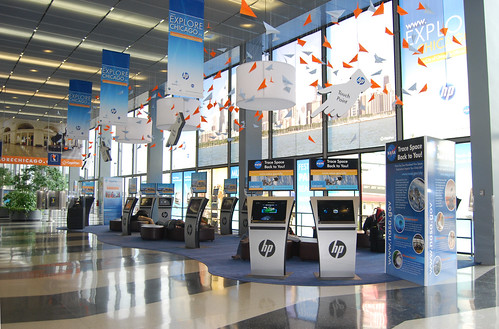
I was going to post the pictures I took today of touch-screens and other displays from the Cleveland airport, but the news about the HP TouchSmart installation at the O'Hare airport was more exciting.
Via Carnegie Mellon: Explore Chicago Via GigaPan 3/30/09 "Panoramas created with GigaPan, a technology developed by Carnegie Mellon’s Robotics Institute and NASA, are featured on a new city Web site. The imagery of iconic Chicago locations can be explored in detail with 50 HP TouchSmart PCs installed throughout the airport by HP and the Chicago Department of Aviation and Office of Tourism."
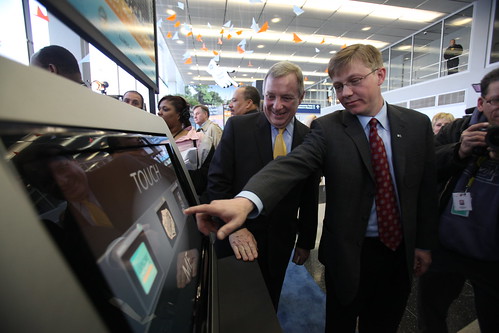
Via Flickr
"Chicago's Mayor Daley, left, and Hewlett-Packard's, Stephen DeWitt, interact with on of the kiosks for Explore Chicago, a state of the art installation featuring touch screen HP computers and high-tech lounges, offering travelers a way to connect to the Chicago Tourism Center at O'Hare Airport Monday, March 30, 2009. During the unveiling, Mayor Daley, announced plans to use Chicago's recently awarded economic stimulus package of $12M for runway expansions at O'Hare Airport. (AP Images for HP/Stacie Freundberg)"