I was looking for some high-quality video clips to use with student at work for activities that incorporate "virtual field trips". I was delighted to find the following clips using the MozoCam system. A customized Segway is used for the MozoCam system, which is why the motion is so smooth.
Showing posts with label HD. Show all posts
Showing posts with label HD. Show all posts
Nov 30, 2011
Aug 5, 2011
GoPro Wearable (extreme) Sports Camera: I Want One! (video)
I'd love to have a GoPro wearable HD camera for creating immersive multimedia content. The only problem is that I'd have to take up extreme sports as a hobby if I wanted to do my own videography.
Take a look at the promo video from the GoPro website - best viewed in full-screen:
I see great possibilities for interactive, "touchable" multimedia content using video captured in this manner!
If you ever wondered what NYC looks like from the POV of a fast and furious skateboard, take a look at this video, "Skate Through NYC With A GoPro":
Thanks to Nat Torkington for sharing the video and link in Google+!
RELATED
Blog Post: Skate Through NYC with a GoPro
Mareadyphotography Blog
Take a look at the promo video from the GoPro website - best viewed in full-screen:
I see great possibilities for interactive, "touchable" multimedia content using video captured in this manner!
If you ever wondered what NYC looks like from the POV of a fast and furious skateboard, take a look at this video, "Skate Through NYC With A GoPro":
Thanks to Nat Torkington for sharing the video and link in Google+!
RELATED
Blog Post: Skate Through NYC with a GoPro
Mareadyphotography Blog
Jul 8, 2010
YouTube's Move to Slower Media: Leanback - in HD, full screen, minimal clicks, merges with your other online "stuff".
The details are demonstrated in the video below:
My hunch?
One motivation behind Leanback is to prepare us for the next wave of online 3D HDTV, which is a "slow media" experience, best viewed from a comfy sofa or recliner. This is the "10-foot experience".
One motivation behind Leanback is to prepare us for the next wave of online 3D HDTV, which is a "slow media" experience, best viewed from a comfy sofa or recliner. This is the "10-foot experience".
RELATED
YouTube Leanback offers effortless viewing
Broadcasting Ourselves ;): The Official YouTube Blog, 7/7/10
Kevin Purdy, Lifehacker, 7/8/10
Brad NcCartym, thenextweb, 7/8/10
YouTube Leanback caters to the lazy: The video service automatically strams HD content based on your prefs Wilson Rothman, msnbc.com, 7/7/10
Brian Barrett, Gizmodo, 7/7/10 YouTube launches Leanback, mobile site gets HTML5 revamp (video)
SOMEWHAT RELATED
Labels:
3D,
3D YouTube,
google,
HD,
interactive,
leanback,
slow media,
slower media,
TV,
YouTube,
youtube leanback

 No comments:
No comments:
May 7, 2010
The attracTable is Coming Soon: Sony will launch a high-definition touch and gesture- interactive tabletop, using Actracsys's technology!
Sony will be introducing a full high-definition interactive table, a result of a collaboration with the Swiss company Atracsys.


(At about 2:14 in the video below, there is a demonstration of an application that recognizes facial features and expressions, which are used to control and manipulate images on the screen.)
Images from the Sony Stand at Vision 2009
Here is an "overview" video that shows a number of uses for the Attractable:
Here is the "Nespresso" table, which provides people with information about the type of coffee that you are drinking. It makes more sense as demonstrated in the video.
Atracsys @ Baselworld 2010
beMerlin: Interactive gesture-based application for retail:

(At about 2:14 in the video below, there is a demonstration of an application that recognizes facial features and expressions, which are used to control and manipulate images on the screen.)
Images from the Sony Stand at Vision 2009
Here is an "overview" video that shows a number of uses for the Attractable:
Here is a version of the atracTable, using a tangible user interface to create music:
Here is the "Nespresso" table, which provides people with information about the type of coffee that you are drinking. It makes more sense as demonstrated in the video.
Atracsys @ Baselworld 2010
beMerlin: Interactive gesture-based application for retail:
Labels:
atracsys,
attractale,
beMerlin,
gestures,
HD,
interactive,
sony,
surface,
tabletop,
touch
No comments:
No comments:
Nov 25, 2009
"Throw Your Data into Different Environments" - UC San Diego's NexCAVE: High Definition Virtual Reality for Interactive Visualization-
What is NexCave? It is an array of LCD panels that provides a projector-free visualization display that enables the visualization of massive datasets in great detail, at high speeds. It was created at Calit2's Virtulab, under the direction of Research Scientist Tom DeFanti. The bonus of this system is that it is much less costly than traditional VR Cave projection systems.
"NexCAVE exploration of Jordan archaeological excavation site. Speaker: Tom Levy, Professor, UCSD and Associate Director, CISA3."-YouTube description
NexCave Demo 3 of Wind Patterns, with 3D sound and HD monitors.
NexCave Display of 3D Model of Calit2 at UC San Diego
RELATED
JVC Introduces the NexCAVE System
"JVC’s Professional Products division is proud to announce today that the California Institute for Telecommunications and Information Technology has developed a new immersive visualization system they call the NexCAVE. This device uses nine GD-463D10U 3D HD monitors to give the user the feeling that they are in the environment. All of these displays feature a 46” diagonal screen, full HD (1920 x 1080) resolution, and 2000:1 contrast ratio. The NexCAVE is created by the same developers who created the CAVE system, which uses 3D projectors to turn a room into a 3D environment. The use of monitors instead of projectors allows for a more compact system that can also be portable for traveling purposes. Unfortunately their isn’t any word when the NexCAVE will be released at this time." -HDTV Review 11/24/09 (Via ITVT)
University of California's Calit2 Develops Immersive 3D Visualization System Using JVC Monitors -Tracy Swedlow, InteractiveTV Today 11/24/09
"Calit2 research scientist, Tom DeFanti, and his partner, Dan Sandin, began designing visualization systems over 35 years ago when they co-founded the Electronic Visualization Laboratory at the University of Illinois at Chicago. According to DeFanti, back in 1991 the pair conceived of the original CAVE system using projectors to reconstruct a 3D surround environment. According to JVC, early projector-based virtual reality (VR) systems were generally limited by two major problems: resolution was "fair at best," due to limitations in computer processing power and projector technology; and the systems required a very large dedicated space--since users could block images projected by front projectors, rear projectors, which required sufficient throw distance, were necessary."


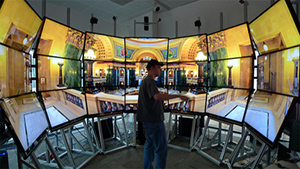
"NexCAVE exploration of Jordan archaeological excavation site. Speaker: Tom Levy, Professor, UCSD and Associate Director, CISA3."-YouTube description
NexCave Demo 3 of Wind Patterns, with 3D sound and HD monitors.
NexCave Display of 3D Model of Calit2 at UC San Diego
RELATED
JVC Introduces the NexCAVE System
"JVC’s Professional Products division is proud to announce today that the California Institute for Telecommunications and Information Technology has developed a new immersive visualization system they call the NexCAVE. This device uses nine GD-463D10U 3D HD monitors to give the user the feeling that they are in the environment. All of these displays feature a 46” diagonal screen, full HD (1920 x 1080) resolution, and 2000:1 contrast ratio. The NexCAVE is created by the same developers who created the CAVE system, which uses 3D projectors to turn a room into a 3D environment. The use of monitors instead of projectors allows for a more compact system that can also be portable for traveling purposes. Unfortunately their isn’t any word when the NexCAVE will be released at this time." -HDTV Review 11/24/09 (Via ITVT)
University of California's Calit2 Develops Immersive 3D Visualization System Using JVC Monitors -Tracy Swedlow, InteractiveTV Today 11/24/09
"Calit2 research scientist, Tom DeFanti, and his partner, Dan Sandin, began designing visualization systems over 35 years ago when they co-founded the Electronic Visualization Laboratory at the University of Illinois at Chicago. According to DeFanti, back in 1991 the pair conceived of the original CAVE system using projectors to reconstruct a 3D surround environment. According to JVC, early projector-based virtual reality (VR) systems were generally limited by two major problems: resolution was "fair at best," due to limitations in computer processing power and projector technology; and the systems required a very large dedicated space--since users could block images projected by front projectors, rear projectors, which required sufficient throw distance, were necessary."
-Tiffany Fox, US SanDiego News Center 8/17/09

-Doug Ramsey, UC San Diego News Center 9/25/09
I like the pictures. In addition to use for visualization, this system might be a great platform for interactive multimedia art installations!
I like the pictures. In addition to use for visualization, this system might be a great platform for interactive multimedia art installations!
May 29, 2009
Zune HD Preview via Gizmodo
Zune HD Video Hands On from Gizmodo on Vimeo.
I need to give this some thought....like the iPhone, the Zune has an accelerometer.
Labels:
accelerometer,
cell phone,
gizmodo,
HD,
iPod touch,
mobile technology,
preview,
Zune
No comments:
No comments:
Subscribe to:
Posts (Atom)