Showing posts with label simulations. Show all posts

Nov 25, 2009

"Throw Your Data into Different Environments" - UC San Diego's NexCAVE: High Definition Virtual Reality for Interactive Visualization-

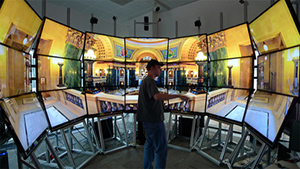
What is NexCave?  It is an array of LCD panels that provides a projector-free visualization display that enables the visualization of massive datasets in great detail, at high speeds. It was created at Calit2's Virtulab, under the direction of Research Scientist Tom DeFanti. The bonus of this system is that it is much less costly than traditional VR Cave projection systems.


"NexCAVE exploration of Jordan archaeological excavation site. Speaker: Tom Levy, Professor, UCSD and Associate Director, CISA3."-YouTube description

NexCave Demo 3 of Wind Patterns, with 3D sound and HD monitors.


NexCave Display of 3D Model of Calit2 at UC San Diego


RELATED
JVC Introduces the NexCAVE System
"JVC’s Professional Products division is proud to announce today that the California Institute for Telecommunications and Information Technology has developed a new immersive visualization system they call the NexCAVE. This device uses nine GD-463D10U 3D HD monitors to give the user the feeling that they are in the environment. All of these displays feature a 46” diagonal screen, full HD (1920 x 1080) resolution, and 2000:1 contrast ratio. The NexCAVE is created by the same developers who created the CAVE system, which uses 3D projectors to turn a room into a 3D environment. The use of monitors instead of projectors allows for a more compact system that can also be portable for traveling purposes. Unfortunately their isn’t any word when the NexCAVE will be released at this time."  -HDTV Review 11/24/09 (Via ITVT)


University of California's Calit2 Develops Immersive 3D Visualization System Using JVC Monitors -Tracy Swedlow, InteractiveTV Today 11/24/09
"Calit2 research scientist, Tom DeFanti, and his partner, Dan Sandin, began designing visualization systems over 35 years ago when they co-founded the Electronic Visualization Laboratory at the University of Illinois at Chicago. According to DeFanti, back in 1991 the pair conceived of the original CAVE system using projectors to reconstruct a 3D surround environment. According to JVC, early projector-based virtual reality (VR) systems were generally limited by two major problems: resolution was "fair at best," due to limitations in computer processing power and projector technology; and the systems required a very large dedicated space--since users could block images projected by front projectors, rear projectors, which required sufficient throw distance, were necessary."


-Tiffany Fox, US SanDiego News Center 8/17/09

-Doug Ramsey, UC San Diego News Center 9/25/09

I like the pictures. In addition to use for visualization, this system might be a great platform for interactive multimedia art installations!




May 31, 2009

RENCI at UNC-Chapel Hill: Serious Gaming and Simulation, Unity 3D Platform

VIDEO
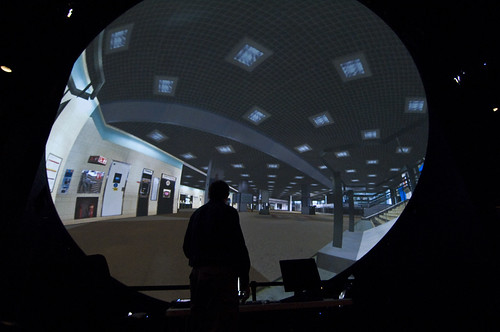
Running the Unity 3D Game Engine in a Global Immersion 4-Projector Dome System at the RENCI@UNC Engagement Center


For more information:
Serious Gaming and Simulation at RENCI@UNC

"
The application of game technology to teaching, training, and research has been a topic of interest at RENCI@UNC. More specifically, the adaptation of game engines and 3D environments to the specialized visualization environments at the engagement center is a promising area for experimentation and collaboration...We very recently obtained copies of Unity, and have been working through some of the basics. One of the first activities was to create specialized code to show Unity-built 3D environments in our Global Immersion dome system. This was successfully accomplished with a good bit of code-hacking to render the proper camera views and viewports for the four channel dome system. There are some known issues with the Windows stand-alone viewer that we were able to work around. We did some imaginative manipulation of the Unity Plug-in using a browser embedded within a WPF application that allows arbitrary screen resolutions, as well as spanning across multiple displays. Look for a post later with some technical details."
FYI

Here are some pictures from RENCI:

http://unc.renci.org/wordpress/wp-content/themes/renci2.0/images/sections/resources/visualization-resources-b.jpg

http://unc.renci.org/wordpress/wp-content/uploads/2009/03/dome-001-300x225.jpgdome-003-a
dome-003-ahttp://farm4.static.flickr.com/3085/3177205942_79d56b3481.jpg

Aug 28, 2008

Surface Computing, Health, and Hands-on Science Education

"....from the first time I saw surface in Andy Wilson's lab at Microsoft Research, I knew it had healthcare written all over it. It has taken some time to bring together the right developers and partners to apply Surface technology in health, but we are finally there." -Bill Crounse, MD, Microsoft HealthBlog

As I've previously suggested, surface computing would be useful in education K-12 settings. One look at the graphics posted below at a demonstration about Microsoft Surface in Health.

We know that one of the challenges in our public schools is to to encourage more students to take STEM-related courses. (If you are not familiar with the acronym, STEM stands for Science, Technology, Engineering, and Mathematics.) One look at the hands-on graphics below might convince reluctant students to sign up for class!


The video of the 3D interactive heart simulation can be found at the bottom of the following post:

Microsoft Health Blog

Mar 6, 2008

More about virtual worlds in education: Edutopia's articles and resources

The recent on-line newsletter from Edutopia has a list of links of articles and media about virtual worlds and games in education. This information compliments the video, "Virtual Worlds Tour", highlighted in my previous post.

Get a Life: Students Collaborate in Simulated Roles (Laila Weir)

The School of Second Life (Wagner James Au)

Simulation Nation: The Promise of Virtual Learning Activities: Inventive computer sims can turn dull lessons into hyperreal experiences, if we can get educators to use them" (Marc Prensky)

Related video: No Gamer Left Behind "Computer simulations area natural learning tools to a generation of video game players"

Let the Games Begin: Entertainment Meets Education (Jenn Shreve)

Related:

Loud and Clear: Students Find Their Voices Through Multimedia
(Edutopia Staff)

Edutopia is part of the non-profit George Lucas Educational Foundation

Post a comment if you are using virtual worlds or games in your school!

Oct 18, 2007

Microsoft UK: "ThinSight" Multi-touch Technology on a Laptop

(Photos from New Scientist)

Tom Simonite's article in a recentNewScientist article reviews a prototype for a touch-screen lap-top using "ThinSight", developed by Microsoft Research. Other companies are researching similar systems.

Multi-touch screens and surfaces support the work of people who increasingly rely on visualization or interactive multimedia to do their jobs. In addition, 3D multi-touch applications created for laptops and tablet PC's might be good for education, training simulations, and serious games.

Oct 12, 2007

SimSchool: Articles and Resources about Simulation & Games in Education

Simulations and games are interactive forms of multimedia that have become the focus of research and practice in education. A collection of articles and research reports regarding the use of simulations and video/computer games for teaching and learning can be found on the Simulations & Games in Education section of the SimSchool website. Authors include Mark Prensky, Kurt Squires, Chris Dede, and Chuck Aldrich.

Jun 18, 2007

Direct link to the Rome Reborn 1.0 website

I did a little hunting and found the main website for Rome Reborn 1.0, at the Institute for Advanced Technology in the Humanities at the University of Virginia. Here is a blurb from the website about the history of Rome Reborn:

"From 1997 to 2007 the UCLA Cultural Virtual Reality Laboratory (CVRLab), the UCLA Experiential Technology Center (ECT), the Reverse Ingineering (INDACO) Lab at the Politecnico de Milano, and the Institute for Advanced Technology in the Humanities (IATH) of the University of Virginia collaborated on a project to crate a digital model of ancient Rome as it appeared in late antiquity...."

News video about Rome Reborn:


Links:
UCLA Cultural Virtual Reality Lab
UCLA Experiential Technology Center
Institute for Advanced Technology in the Humanities
Politecnico di Milano

Apr 11, 2006

Update: Games, Simulations, and Virtual Worlds WebQuest (QuestGarden)

UPDATE 12/25/09


This post is over three years old, and I have not checked the links.  It was created as part of a project for a course I took that focused on on-line communication tools and designing e-Learning experiences, in 2006.  I used this blog for a few months as an on-going resource for participants of a 3-hour workshop that was held at the 2006 annual conference of the National Association of School Psychologists in Anaheim, CA.   At the time, I was also taking "Virtual Reality in Training and Education", and chose to explore the theme of the webquest, games, simulations, and virtual worlds.


Much has happened since I created the webquest.  If you are here because a search led you to this page, do a search of this blog site and I'm sure you will find some interesting links and information!


Hi.

The Games, Simulations, and Virtual Worlds WebQuest is posted at Quest Garden. This WebQuest was designed for school psychologists who attended the "Interactive Multimedia Technology: A Tool for Intervention and Prevention" workshops in February or March of 2006.
Feel free to explore the WebQuest if you aren't a school psychologist, but are interested in this topic!

To prepare for this WebQuest, first visit the previous post on this topic. The WebQuest includes a WebQuest journal with links to a variety of interesting websites. Many of the websites are interactive or media-rich. There is a rubric that can be used as a guide during the Webquest. The WebQuest can be modified for staff development and related training activities.

Quia Website Activities for School Psychologists/Workshop Participants:

I have set up a web page at Quia that has links to activities that relate to topics discussed in the workshop. You will find a needs assessment and action plan for school psychologists to complete. You can also find a WebQuest Scavenger Hunt, a shorter version of the quest posted at QuestGarden, with links and questions related to each link, in the form of a quiz. There is a "class roster" under the name of School Psychologists for workshop participants and those interested in participating in on-line learning activities related to the topic of the workshop.

-Lynn

Games, Simulations, and Virtual Worlds - preparing for the WebQuest activities


WebQuest Information:

For those of you who work in educational settings, the links you will explore during the WebQuest activities will provide you with information about various technologoies that can be harnessed to enhance academic and social engagement . These applications have the potential for improving the outcomes of intervention and prevention efforts in your schools.

During your quests, you will need the following tools:

Getting Started:

If you haven't been reading about interactive multimedia, simulations, games, or virtual worlds in education, keep in mind that technology is rapidly changing. Although the links on the WebQuest are checked periodically, you may encounter broken links that I have not yet discovered.