Smartphones, iPads, tablets, and other gadgets will be given as gifts to spread the holiday cheer, putting more computational power in the hands of people of all ages and walks of life than ever before. Walk into any toy section, and you'll see tablets, games, and accessories designed for toddlers. Many little ones have not known a world without a "computing device". Although not all children will grow up to be computer scientists, they will need to be prepared during their school years for an increasingly technology-infused society.
One of the things teachers (and parents) will need to know more about is the concept of computational thinking.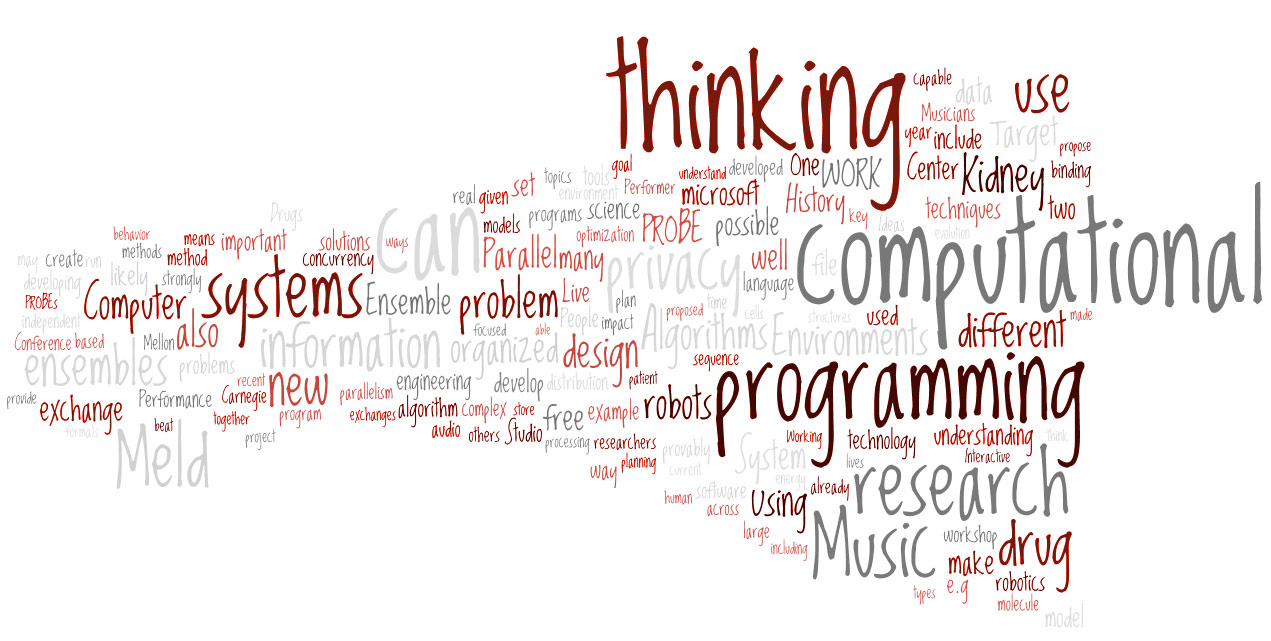
Credit: wordle.net; Center for Computational Thinking, Carnegie Mellon
No longer limited to mathematicians or computer scientists, computational thinking something that is essential to all disciplines. For this reason, representatives from ISTE (International Society for Technology in Education) and CSTA (Computer Science Teacher's Association) have developed the Computational Thinking Tookit, available on-line, "to prepare young learners to become computational thinkers who understand how today's digital tools can help solve tomorrow's problems."
To help spread the word, I'd like to share a few videos and resources on this topic. The first one was created by ISTE, CSTA, and NSF, and provides a short overview of ways technologies have changed the way people do things, and how computational thinking is an essential skill for all:
In the next video, various people who work at Google discuss the importance of computational thinking and how it is applied in their work to solve problems. One interesting example is how Pegman, the little yellow figure in Google's Street View in Google Maps became "smarter" through the development team's use of computational thinking. K-12 resources are available on Google's Exploring Computational Thinking website, and a list of links to additional web-based resources can be found on the Web Resources page.
Solving Problems at Google Using Computational Thinking (Google)
Jeannette M. Wing, a professor at Carnegie Mellon, believes that computational thinking is not just for computer scientists - it is important for people from all disciplines and walks of life. She discusses the concept in the video below:
Computational Thinking and Thinking About Computing
RELATED
Center for Children and Technology
The Curiosity Cycle: Preparing Your Child for the Ongoing Technological Explosion
Author: Jonathan Mugan
10 Emerging Education and Instructional Technologies that All Educators Should Know About
K. Walsh, 9/9/12
One of the things teachers (and parents) will need to know more about is the concept of computational thinking.
Credit: wordle.net; Center for Computational Thinking, Carnegie Mellon
No longer limited to mathematicians or computer scientists, computational thinking something that is essential to all disciplines. For this reason, representatives from ISTE (International Society for Technology in Education) and CSTA (Computer Science Teacher's Association) have developed the Computational Thinking Tookit, available on-line, "to prepare young learners to become computational thinkers who understand how today's digital tools can help solve tomorrow's problems."
To help spread the word, I'd like to share a few videos and resources on this topic. The first one was created by ISTE, CSTA, and NSF, and provides a short overview of ways technologies have changed the way people do things, and how computational thinking is an essential skill for all:
In the next video, various people who work at Google discuss the importance of computational thinking and how it is applied in their work to solve problems. One interesting example is how Pegman, the little yellow figure in Google's Street View in Google Maps became "smarter" through the development team's use of computational thinking. K-12 resources are available on Google's Exploring Computational Thinking website, and a list of links to additional web-based resources can be found on the Web Resources page.
Solving Problems at Google Using Computational Thinking (Google)
Jeannette M. Wing, a professor at Carnegie Mellon, believes that computational thinking is not just for computer scientists - it is important for people from all disciplines and walks of life. She discusses the concept in the video below:
Computational Thinking and Thinking About Computing
RELATED
Center for Children and Technology
The Curiosity Cycle: Preparing Your Child for the Ongoing Technological Explosion
Author: Jonathan Mugan
10 Emerging Education and Instructional Technologies that All Educators Should Know About
K. Walsh, 9/9/12