Showing posts with label music technology. Show all posts

Jul 15, 2012

Catching up on music technology: Tornado Twins' "How to Make Dubstep in 10 Minutes"


I've been neglecting my musical experiments for too long.  My Yamaha Motif 8 is about 9 years old, and my last copy of MOTU Digital Performer is on a computer that died in 2007 or so.  In the past, I found that immersing myself in wave forms and playing around with sound synthesis was quite relaxing.  I miss it.


Since I'm not a performing musician, I told myself not to trouble with researching electronic keyboard/workstations and fancy software. The practical thing to do is to stick with Garage Band to give life to the musical ideas that pop into my head.  I've played with music-making on my iPhone and iPad, hoping it would dampen my electronic music urge, but wasn't quite right.


What to do?  I still am not sure what I will do.  However, a link from a tweet by the Tornado Twins caught my eye today.  It led me to a short video that put me back into the music-creating groove.  Even if you aren't into music technology or electronic music, you might enjoy the opportunity to view musical creation visualized in the video, and appreciate the enthusiasm of the twin.


HOW TO MAKE DUBSTEP IN 10 MINUTES (Using the Dubstep Master Kit)


RELATED 
Tornado Twins Dubstep Master Kit
MOTU Digital Performer
Tornado Twins (The Tornado Twins are involved in music as well as video game development.)


SOMEWHAT RELATED

Comment: 
I plan to devote periodic posts to music technology in the future a bit more frequently than in the past.  It is a topic that is dear to my heart.
A little "history":
In the early 1990's, I bought an Ensonic KS-32 weighted-action keyboard.  I was exasperated by the 250-page manual that came with my keyboard. It was time to upgrade the computer, so I got a Mac Performa 600 CD, and purchased the very first version of MOTU's FreeStyle software to ease the music creation process.  I have been pleased with all of my MOTU products over the years, as well as the excellent tech support. 

MOTU Freestyle Sequencing Software (review)
Mike Collins, Sound on Sound, 1995


May 28, 2012

Interactive Music Challenge: The Reactable & the Reactable for Children with Autism Spectum Disorders

What I'd like to share today might be of interest to educators, techies, musicians, parents, and students. If you create a composition using the Reactable Mobile app and submit it, you might have a chance of winning your very own Reactable Live!  


Information about the challenge can be found on the Reactable website.


You can find information about creating music with Reactable Mobile for your phone or tablet (Android or Apple) on the Reactable Mobile site. I especially like that the company provides a load of support through the Reactable Community.


Acquisition of Joint Attention and Social Abilities of Children with Autism Spectrum Disorders

The Reactable provided the centerpiece of Lilia Villafuerte Bazan's work for her Master thesis.  Her project focused on the acquisition  of joint attention and social abilities of children with autism spectrum disorders through music. Lilia's work was through the Music Technology Group at Universitat Pompeu Fabra, under the direction of Dr. Sergi Jorda.   

I was delighted to see Lilia's presentation of her work, along with the video, during the recent CHI 2012 conference. 


Project website: 
http://www.villafuerte.info/ascchildrenandtuis
Master Thesis:
http://www.villafuerte.info/wp-content/uploads/2012/05/LiliaVillafuerte_MasterThesis.pdf


-Lilia Villafuerte Bazan

RELATED
REACTABLE LIVE

Comment:
If you follow this blog, you probably know that I am a school psychologist who has a background in technology, music, and related arts.  I spend much of my work week with young people who have severe autism and other disabilities. I also work at a magnet high school for technology and the arts.  I'd like a Reactable for students at both schools!

Dec 15, 2011

Christian Bannister's Interactive Multi-touch and Gesture-based Subcycle Project. Use your hands to shape sound, create, and manipulate music. Wow!!

I came across a link to Christian Bannister's Subcycle Labs website when I was taking a look at the Creative Applications Network website.


If you have an interest in music technology and innovative gesture/multitouch applications, you'll appreciate the details that are shared on the Subcycle website.  In the meantime, take the time to watch a few of Christian's videos.  Enjoy!


Blip Shaper Walkthrough

Blip Shaper Walkthrough from christian bannister on Vimeo.
"a) creating percussive patterns with monome b) shaping the individual sounds that make up the patterns with multitouch gestures c) recording touchscreen gestures as automation d) storing, duplicating and navigation patterns e) recording the resulting audio to a dynamic buffer f) manipulating the buffer with a multitouch cut-up approach g) visualizing everything with dual screens"
Subcycle Walkthrough

Subcycle Blip Shaper from christian bannister on Vimeo.
"a) creating percussive patterns with monome b) shaping the individual sounds that make up the patterns with multitouch gestures c) recording touchscreen gestures as automation d) storing, duplicating and navigation patterns e) recording the resulting audio to a dynamic buffer f) manipulating the buffer with a multitouch cut-up approach g) visualizing everything with dual screens"


The following information describing the Blip Shaper is from Christian's Subcycle website/blog:
"For the drum sounds I have Drumaxx running for synthesized sounds and Battery running for sampled sounds.  These are running in parallel so for each voice there is a separate patch running in each VST.  The Parameters are modified with the touchscreen independently but in all cases a single touch gesture on the X-Axis will cross fade between the sampled version of the sound and the synthesized version of the sound.  I love this because I have never seen this before and I can never decide which technique I like better.  The synthesized drums are more malleable and have more interesting parameters to play with but the sampled sounds seem more substantial.  I will post a detailed list of parameters and gestures in the future."   


Christian currently uses Max for Live (ableton), and codes with Processing/Java, using Eclipse for organization.

Autopilot - Subcycle
autopilot - subcycle labs from christian bannister on Vimeo.
"sound visualization, multi-touch interface, break beat performance engine, autopilot, spacialized sound, dsp, max/MSP, fm synthesis, sonic navigation, sound storm visualization, time machine, granular, interactive sound sculpture, joystick array, more at subcycle.org"


SOMEWHAT RELATED 
Community Core Vision
NUI Group
BTW,I'm wondering if Christian or other NUI group members would like to do something with some of my ideas that incorporate interactive music. To learn more, see my post, "It must be  Voronoi: Looking for ideas for my music+art+dance+tech dream...."
...


....

Jul 12, 2011

Summer Break: Music Apps, Multimedia, Kinect, My New iPad2, Tech-reading, Google+, Dancing...

I'm on summer break, which for me, means that I spend an increased amount playing/creating music and doing all of the other fun stuff I don't have much time for during the school year. I'm still exploring what I can do with my new iPad2 - there are so many music apps!  My favorite at this moment is Garage Band. It keeps me engaged for hours, and I can take it with me anywhere I go.  I'm also exploring iPad apps for education and students with special needs, since many of the young people I work with have autism spectrum disorders.  They all really love music.


Today, I came across turntable.fm, a "social-djing" website, from a link shared by Dimitri Diakopoulos.  I think it would be fun to play with.


Turntable.FM, The Fastest-Growing Music Service You're Not Using
William Fenton, PC Magazine, 6/23/11
Social DJing with Turntable.FM
Andrew Mager, 5/28/11


I'm still plowing through technology journals and zines from previous months - I had to skip over my stack to read the cover article of the most recent Communications of the ACM:
Michael Edwards, University of Edinburgh, 2011


I LOVE the design of this cover. It would make for a nice interactive interface for an iPad music app. Or a larger touch-screen display. Or even a SMARTBoard! (BTW, My first computer-related course was Computer Music Technology, in 2003. My undergraduate honors research (psychology), years ago, focused on constructive cognition and music recognition/memory. This topic is dear to my heart.)

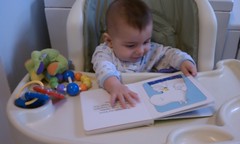
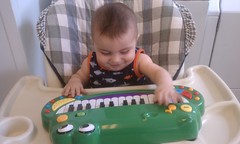
I've spent some quality time with my first grand-baby this summer.  Although his "screen time" is limited, given his age of 7 1/2 months, he enjoys playing with music on my iPad.  He likes the drums found in the iPad GarageBand application.  Here he is playing with NodeBeat, an app created by Seth Sandler and Justin Windle:


Most of his time is spent off-screen:


Over the last few months, there has been a surge of interactive touch-enabled apps for education, including some for young people with special needs.  This will be the topic of a few of my future posts.

Jul 5, 2011

GarageBand on the iPad2 is Awesome!

For just $4.99, this app has given me hours of joy - and I've only had it for a week!  The first time I played around with it, I exclaimed that I no longer have a need for my Motif 8 keyboard.

(Seriously, my husband now thinks I'll be unloading my keyboard on eBay or Craigslist soon.)

Below are a couple of videos to give you an idea of what the iPad version of GarageBand is all about:

GarageBand for iPad


Be sure to visit soon for an update - I'll include videos of my own.

Apr 30, 2011

Take a short break to enjoy a performance by the KAIST Mobile Phone Orchestra!

Thanks to CreativeApplications.Net for sharing this video!

KAMPO Performance @INDAF 2010 from Sihwa Park on Vimeo.

KAMPO KAIST Mobile Phone Orchestra
"Mobile phones (especially smartphones), with more advanced features and computing power than those of ordinary telephones, have been revolutionizing our life and culture in a variety of ways. The KAIST Mobile Phone Orchestra (KAMPO) aims to explore this potential of mobile media for music and media art. In addition to suggesting new and innovative mobile performance paradigms through concerts, KAMPO conducts active research/education in music and mobile media as well as software development." -Intro from the KAMPO website

Apr 23, 2011

April 25th Release Date: Play and Experiment with Music on your iPad/Phone/Pod with NodeBeat iOS Music Sequencer by Affinity Blue, by Seth Sandler and Justin Windle

If you love music and have an iPad, iPhone, or iPod touch, you'll have fun exploring and experimenting with NodeBeat. As soon as I get my iPad, I plan to get this app! 


"NodeBeat is an experimental node-based audio sequencer and generative music application for the iPhone, iPod Touch and iPad. NodeBeat is designed to let you create a variety of rhythmic sequences and ambient melodies in an intuitive fashion. It is scheduled for release on April 25th." -Affinity Blue


NodeBeat - iOS Music Sequencer from AffinityBlue on Vimeo.

NodeBeat is a collaboration between Seth Sandler and Justin Windle. It was developed using openFrameworks, with PureData for audio synthesis.  According to the NodeBeat website, "Octaves and Notes make up the two types of nodes. Octaves pulse and send messages to Notes within proximity. Each Octave is assigned a random octave and each Note, a random note; therefore, a Note will play in several octaves depending on the Octave it's connected to. Pause nodes to create your own beats or let them roam free to have them generate their own." Features include adjustable node physics, node add/remove, pitch shift, adjustable pulse rate and beat sync, adjustable echo, attack, decay, and release for creative sound sculpting, and for the iPad, audio waveform display and landscape/portrait views.

RELATED
NodeBeat website
Seth Sandler's posts about music
Seth's posts and videos about AudioTouch, and interactive multi-touch interfaces for computer music exploration and collaboration.
Soulwire (Justin Windle's blog)


Cross-posted on The World Is My Interactive Interface and TechPsych blogs.

Nov 4, 2010

USB Midi on the iPad: Video demonstration of iOS 4.2, supports wireless MIDI


Video from the MooCowMusic YouTube Channel

RELATED
On iPad, iPod touch and iPhone, New MIDI Support, Via Wires, Wireless
Pete Kirn, Create Digital Music, 11/3/10
MIDI on the iPAD
Display Blog, 11/4/10

Thanks to Johannes Schöning for the link!
(FYI: Johannes will be at the Interactive Tabletops and Surfaces conference, held in Saarbrucken, Germany, from November 8-10.)

Jul 1, 2010

Reactable Live! at Sonar Barcelona 2010 - (You can see one at Discovery Place in Charlotte, NC.)

I like music technology. I like interactive, tangible table systems.  I like the Reactable!


To understand this system, see it in action!

Below is a video of Reactable Live!, Performed at Sonar Barcelona 2010 on June 18th. The music and performance is by Carles Lopez, and the video was by Marc Morera.

"Reactable in Concert by Carles López sounds like electronic house, minimal, electro, techno, idm, dnb…"

Here is a video of children playing with the Reactable, at Sonar Kids, Barcelona, 2009:


I recently learned that there is a Reactable in my hometown!
The Reactable Experience was installed at Discovery Place in Charlotte.  Discovery Place is the children's science museum for the metropolitan Charlotte, N.C. region. Below is a picture from the Discovery Place museum:


The Reactable is part of a new exhibition, "Think it up"  Here's the description from the Discovery Place website:

"The Reactable is a cutting edge electronic musical instrument merged with a visual experience. Special objects are placed on a translucent surface which trigger sound clips and audio modulation. The sound produced by the objects is represented visually on the surface, providing feedback and guidance for the creation of new music."


This version of the Reactable is for museums, science centers, schools, universities, and other public spaces.  It is an outgrowth of the original Reactable that was designed for musicians. This version is intuitive and invites people to share and create music collaboratively.


RELATED
Reactable Experience brochure (pdf)

Nov 6, 2009

The Vodafone Symphonia- A Symphony of Phones, Via Henry Jenkins, author of "The Wow Climax: Tracing the Emotional Impact of Popular Culture"

I learned about the Vodafone Symphonia video through Henry Jenkins. If you haven't heard of him by now, and you've found your way to this post, you should!


Henry Jenkins co-founded the Comparative Media Studies Program at MIT, and now is the Provost's Professor of Communications, Journalism, and Cinematic Art at the University of Southern California.


Be sure to read Henry's recent blog post, Strange Overtures: Vodafone, Tchaikovsky, Ernie Kovacs and the "Wowness" of New Media, focuses on how joyful it is to receive a delightful gifts, such as the VodaFone video,  and how this sent to him by a former student. In this post, he relates this experience to some of his thoughts from his recent book, The Wow Climax: Tracing the Emotional Impact of Popular Culture.


I came across the link to the video through Facebook, since Henry decided to circulate the video. (I'm really Henry Jenkin's FAN.)


FYI: Today, 11/6/09, 12:00 PM - 1:00 PM, Henry is participating in a free webinar, "Moving from "Sticky" to Spreadable": The Antidote to "Viral Marketing" and the Broadcast Mentality". 


VodaFone Symphonia


The Making of the Vodafone Symphonia


The Making of the Vodafone Symphonia Part II


RELATED
Vodafone's Symphonia Website
(You can download the full track of the Symphonia and the 53 ringtones)

Oct 25, 2009

Interactive multi-touch for sound design, dj-ing, and music creation

NUI-Group member Christian Bannister, a musician, designer, and developer behind Subcycle Labs has been experimenting with music and multi-touch technology and interactions. Here's a demonstration of what he's come up with so far:


multi-touch the storm - interactive sound visuals - subcycle labs from christian bannister on Vimeo.
.
"The big picture goal of this project is to bridge the gap between sound visualization and musical instrument. With multi-touch interaction it is possible to manipulate multiple characteristics of a sound—directly and visually. Right now a lot of electronic music involves staring at the back of the performers laptop. This is a shame because in many cases a lot of really interesting things are happening on the computer that the audience is completely unaware of. This project hopes to create a common visual language and experience for the electronic musician and the audience by enhancing the perception of sound and music on both sides...These sketches are built with Processing and Max/MSP networked with OSC on a single computer..." -Christian Bannister


JazzMutant Lemur
The multi-touch tech company now known as Stantum evolved from JazzMutant, Jazzmutant was founded in 2002 by Guilluame Largillier and Pascal Joguet, and joined by Julien Olivier in 2003. The original focus was to create a multi-touch controller for music applications, and the Lemur was born. It is now in version 2, with features such as a gesture object that provides three ways for people to interact with sound, extended scripting abilities, and remote control of your computer's mouse cursor or keyboard.  Stantum recently developed a next-gen multi-touch screen system for use in mobile devices such as smart phones and netbooks.  (I'll discuss this further in a future post.)


Mapping Ableton Live to Jazz Mutant's multi-touch Lemur for sound design:


Additional tutorials can be found the Jazzmutant YouTube channel.


Ableton Live, the software used in the above video, will include Max. Max/MSP is now known as MAX 5:
"In use for over twenty years by performers, composers, artists, scientists, teachers, and students, Max is the way to make your computer do things that reflect your individual ideas and dreams. Version 5 is a dramatic transformation of Max that begins a new chapter in the program's history."

RELATED
Video:  Max for Live
Max is a product of cycling74
Cycling74 created the Make Controller Kit, which includes fully programmable controllers. The kit is networked based. It is capable of working with actuators and can read sensor information into Max.
Jamoma, a platform for interactive art-based research and performance. Jamoma is the prototyping environment for SpatDIF, the Spatial Sound Description Interchange Format, and GDIF, the Gesture Description Interchange Format.
GDIF: Gesture Description Interchange Format, a tool for music related movements, actions, and gestures 
Stantum's Mobile Phone Multi-touch Interface:  Demonstration of precise interactions on a resistive touch screen

How the Stantum's Resistive Multi-Touch Screen Works


GDIF: Gesture Description Interchange Format, a tool for music-related movements, actions, and gestures.

There has been a flurry of work in the computer music technology world that relates to what has been going on with interactive display technology, multi-touch & gesture interaction. I came across a link to the GDIF website when I was searching for information about interactive music and the use of multi-touch technologies for a future blog post.   

So what is GDIF?  Gesture description interchange format

"The Gesture Description Interchange Format (GDIF) is being developed as a tool for streaming and storing data of music-related movements, actions, and gestures.  Current general purpose formats developped within the motion capture industry and biomechanical community (e.g. C3D) focus mainly on describing low-level motion of body joints.  We are more interested in describing gesture qualities, performer-instrument relationships, and movement-sound relationships in a coherent and consistent way.  A common format will simplify working with different software, platforms and devices, and allow for sharing data between institutions."  (The Jamoma environment is used to prototype GDIF.)


Alexander Refsum Jensenius is the man who initiated the GDIF project.  He's written a variety of articles about music, gestures, movement, and emerging technologies.  


Here's Alexander's bio: "Alexander (BA, MA, MSc, PhD) is a music researcher and research musician working in the fields of embodied music cognition and new interfaces for musical expression (NIME) at the University of Oslo and at the Norwegian Academy of Music. He studied informatics, mathematics, musicology, music performance and music technology at UiO, Chalmers, UC Berkeley and McGill. Alexander is active in the international computer music community through a number of collaborative projects, and as the initiator of GDIF. He performs on keyboard instruments and live electronics in various constellations, including the Oslo Laptop Orchestra (OLO)."


Related Publications
Godoy, R. I., E. Haga, and A. R. Jensenius (2006b). Playing `air instruments':Mimicry of sound-producing gestures by novices and experts. InS. Gibet, N. Courty, and J.-F. Kamp (Eds.), Gesture in Human-Computer Interaction and Simulation, GW 2005, Volume LNAI 3881, pp. 256{267.Berlin: Springer-Verlag.
Jensenius, A. R (2009): Motion capture studies of action-sound couplings in sonic interaction. STSM COST Action SID report. fourMs lab, University of Oslo.
Jensenius, A. R. (2007). Action - Sound: Developing Methods and Tools to Study Music-related Body Movement. PhD thesis. Department of Musicology. University of Oslo, Norway
Jensenius, A. R., K. Nymoen and R. I. Godoy (2008): A Multilayered GDIF-Based Setup for Studying Coarticulation in the Movements of Musicians. Proceedings of the International Computer Music Conference, 24-29 August 2008, Belfast.
Jensenius, A. R., T. Kvifte, and R. I. Godoy (2006). Towards a gesture description interchange format. In N. Schnell, F. Bevilacqua, M. Lyons, and A. Tanaka (Eds.), NIME '06: Proceedings of the 2006 International Conference on New Interfaces for Musical Expression, Paris, pp. 176{179. Paris: IRCAM { Centre Pompidou.}
Kvifte, T. and A. R. Jensenius (2006). Towards a coherent terminology and model of instrument description and design. In N. Schnell, F. Bevilacqua, M. Lyons, and A. Tanaka (Eds.), Proceedings of New Interfaces for Musical Expression, NIME 06, IRCAM - Centre Pompidou, Paris, France, June 4-8, pp. 220–225. Paris: IRCAM - Centre Pompidou. [PDF]
Marshall,M. T., N. Peters, A. R. Jensenius, J. Boissinot, M. M. Wanderley, and J. Braasch (2006). On the development of a system for gesture control of spatialization. In Proceedings of the 2006 International Computer Music Conference, 6-11 November, New Orleans. [PDF]

RELATED
"Sonic Interaction Design is the exploitation of sound as one of the principal channels conveying information, meaning, and aesthetic/emotional qualities in interactive contexts."
SID Action has four working groups:
WG1: Perceptual, cognitive, and emotional study of sonic interactions
WG2: Product sound design
WG3: Interactive art and music
WG4: Sonification


    "SoundHack was my main thing for a long time, and I poured a lot of effort into it. It was the place I put my ideas. I did have something of a mission with SoundHack. I wanted to take some computer music techniques that were only used in academia, and get them out there so that all types of musicians could use them."-Tom Erbe  SoundHack Spectral Shapers


Csound Blog "Old School Computer Music"
"Csound is a sound and music synthesis system, providing facilities for composition and performance over a wide range of platforms. It is not restricted to any style of music, having been used for many years in the creation of classical, pop, techno, ambient, experimental, and (of course) computer music, as well as music for film and television."-Csound on Sourceforge


Quote from Dr. Richard Boulanger (Father of CSound):
"For me, music is a medium through which the inner spiritual essence of all things is revealed and shared. Compositionally, I am interested in extending the voice of the traditional performer through technological means to produce a music which connects with the past, lives in the present and speaks to the future. Educationally, I am interested in helping students see technology as the most powerful instrument for the exploration, discovery, and realization of their essential musical nature - their inner voice."


Upcoming post about innovations at Stantum:
I'll be focusing on Stantum and its music and media technologies division, JazzMutant. in my next post. It is interesting to note that the co-founders of Stantum, Guilliam Largilleir and Pascal Joget, have a background in electronic music.  Guiliam specializes in multi-modal user interfaces and human-machine interface technologies. Pascal has a background in physics and electronics, and has worked as a sound engineer.


My music back-story:


The very first computer-related course I took was Computer Music Technology (in 2003), since I play an electronic midi/digital keyboard and previously tried to teach myself a few things, long before computers and related technologies were "easy" for me to figure out.  During the mid-90's, I tried my hand at Dr. Richard Boulanger's  CSound, and tried to acquaint myself with tools from Cycling'74, but I gave up.  Not long after that, bought the first version of MOTU's  Freestyle, which nicely worked on my Performa 600, hooked up to my Ensoniq 32, after the nice people at MOTU sent me an update that was compatible with my set-up.  Later on,  I came across Tom Erbe's SoundHack freeware.   


A lot has changed since then! 


Oct 12, 2009

Multi-Touch Stereotronic Multi-Synth Orchestra on a Table (Fashionbuddha)

Stereotronic Multi-Synth Orchestra from fashionbuddha on Vimeo.


Here is the info from the YouTube version:
"Fashionbuddha's submission into Microsoft's Surface developer challenge. Robert Lewis did the design and I ported it over to C# from an application we developed with Zach Archer of Z Industries. This new one is not only built on the XNA framework, but it also reads TUIO data from OSC -encoded XML packets over UDP. This means it can work with either Surface or DIY tables without any configuration...I'm using DirectSound for the synthesis. Not shown in this video is the pitch control, which truly warps everything out nicely. :D"

Slideshow


They didn't have this sort of thing when I took computer music technology back in 2003!


RELATED
Fashionbuddha's Interactive Reel

Fashionbuddha Interactive Reel from fashionbuddha on Vimeo.

Fashionbuddha's Animation Reel

Fashionbuddha Animation Reel from fashionbuddha on Vimeo.

Aug 9, 2009

Surface Flight Tracker Video from fboweb labs / flightwise.com, with background music by Art of Noise for your NUI pleasure.


This flight-tracker application for the Surface, looks fun to use. As I watched the video, I realized that it wasn't the application itself that I liked. It was the music that accompanied the video. The choice of music was from the 80's synth-pop band, Art of Noise

Since I'm a music lover, the music got me thinking.

Wouldn't it be great if productivity/work-related applications like Flight Tracker could be developed to provide a means for incorporating a sound-track?


Several thoughts and ideas flashed into my mind:

  • Surface and related natural user interface/interaction (NUI) applications have the potential to transform routine, ho-hum work tasks into activities that are a bit more pleasant. Since people often listen to music while they work, it stands to reason that NUI productivity applications should incorporate a music component, at least as an option.
  • To support a user-centered music platform for NUI applications, the application could incorporate a "smart" music library within the system, with the capability of integrating music libraries and playlists from user's mobile devices, as well as the web, effortlessly.(Of course, there are privacy/security and firewall issues to address, but that is another story.)
  • Users could have a choice of listening to their own music playlists (including a shuffle option, selecting from a variety of presets, or go for something like the iTunes genius effect, listening to music generated from an algorithm that takes into account music preferences and user interaction with the productivity application over time.
  • Since many Surface/NUI applications are designed to support collaborative work and interaction between two or more people, the music situation could get a bit complicated, since people have differing tastes. If co-workers disagreed about the music selection, the program would automatically default to generic elevator music, or silence.
  • NUI applications might even pave the way for a new genre of music. This concept isn't too far-fetched. Think of all the music we've come to love over the years that was composed for movies and even video games!

If you know of anyone that is working on this concept, or would like to collaborate with me sometime in the future on this concept, please let me know. I'm slowly working on an interactive timeline prototype, and I have some ideas about adding a music/sound track component.

RELATED
Art of Noise - Close To The Edit (Version 1):

Nov 20, 2008