Showing posts with label semantic web. Show all posts

Jul 18, 2011

Tools for Knowledge Junkies: Document Cloud, CALAIS , Linked Data

For all of the knowledge junkies out there, here are a few things that might fuel your passion for interactive information exploration and consumption. Although the tools below were adopted by people in journalism/news related fields, I think that they have potential for use in education and other fields. I'm interested in learning more about how people from different disciplines currently use these tools, and I'd also like more to this list.

CALAIS: "We want to make all the world's content more accessible, interoperable and valuable. Some call it Web 2.0, Web 3.0, the Semantic Web or the Giant Global Graph - we call our piece of it Calais. Calais is a rapidly growing toolkit of capabilities that allow you to readily incorporate state-of-the-art semantic functionality within your blog, content management system, website or application." CALAIS is published by Thomson Reuters
MORE ABOUT CALAIS
PR Video for CALAIS:

How CALAIS Works:

CALAIS for Publishers
CALAIS for Bloggers
CALAIS for Software Providers
CALAIS for Content Managers
CALAIS for Developers
Open CALAIS Content Maps by Jer Thorp

"Jer Thorp is a software artist, writer, and educator. He is a contributing editor for Wired UK. He is currently Data Artist in Residence at the New York Times."

DOCUMENTCLOUD
"DocumentCloud runs every document you upload through OpenCalais, giving you access to extensive information about the people, places and organizations mentioned in each."

DocumentCloud Blog from Knight Foundation on Vimeo.
MORE ABOUT DOCUMENT CLOUD
DocumentCloud Merging with IRE 
Amanda Hickman, DocumentCloud, 6/9/11 (Note:  IRE = Investigative Reporters and Editors)
Newsrooms using Document Cloud
Document Cloud: Not Just For Journalists?  (Excellent article!) Konrad Lawson, The Chronicle of Higher Education, 7/8/11 (Konrad is a Ph.D student in the history department at Harvard University.)
For Techies:  Document Cloud's VisualSearch.js | Autocomplete Faceted Search Queries
Losterium Posterious, 7/9/11


LINKED DATA
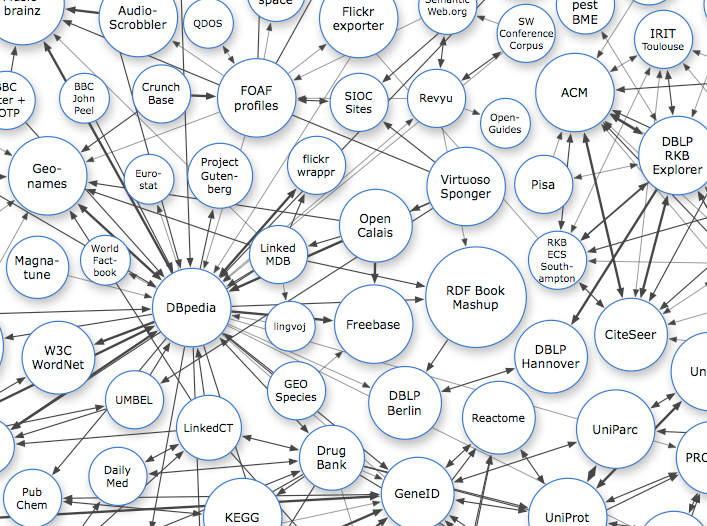
Part of the Linking Open (LOD) Data Project Cloud Diagram, click for full and historical versions...
-linkeddata.org
"Linked Data is about using the Web to connect related data that wasn't previously linked, or using the Web to lower the barriers to linking data currently linked using other methods. More specifically, Wikipedia defines Linked Data as "a term used to describe a recommended best practice for exposing, sharing, and connecting pieces of data, information, and knowledge on the Semantic Web using URIs and RDF.""


Tim Berners-Lee: The Year Open Data Went Worldwide

"....Tim Berners-Lee invented the World Wide Web. For his next project, he's building a web for open, linked data that could do for numbers what the Web did for words, pictures, video: unlock our data and reframe the way we use it together." At TED2009, Tim Berners-Lee called for "raw data now" -- for governments, scientists and institutions to make their data openly available on the web. At TED University in 2010, he shows a few of the interesting results when the data gets linked up."-TED

LDOW2011: Linked Data on the Web workshop


COMMENT
I plan to share more information related to this topic in future posts.  I welcome input and links from my readers!


Apr 24, 2010

Mark Zuckerburg's Recent Keynote at f8 about Facebook's OpenGraph: The goal is to create a connected, mapped web that is more "social, personalized, smarter, and semantically aware".

During the mid-2000s I took a few courses related to web-development and internet programming.  This was before the twitterfacebookyoutube era.  There's a lot of catching up to do.

Today, I'm watching a few videos from the recent f8 conference. It took place on April 21st, 2010 in San Francisco.

So what is f8?

"f8 is a Facebook conference where developers and entrepreneurs collaborate on the future of personalized and social technologies. At f8, members of the Facebook team and the developer community will explore a variety of topics including new tools and techniques, business growth strategies and open technologies." -Facebook


Mark Zuckerburg


You can find more f8 videos by following the link below:
http://apps.facebook.com/feightlive/

Here are some tidbits of info from the first video:
  • The number of people using Facebook on mobile devices is rapidly increasing.
  • More than 400 million people are on Facebook.
  • One step permission is now available for developers and users, users will be clear about what permissions they are given.
  • New policy allows websites to store Facebook users' permission data beyond the previously imposed 24 limit.
  • Facebook is ramping up to handle monitory transactions:  See http://developers.facebook.com/credits
During the first video, Open Graph is discussed:

  • "Open Graph puts people at the center of the web, becoming a set of personally and semantically meaningful connections between people and things".
  • Facebook maps out people and relationships of the online "social graph".
  • Pandora maps out music connections, Yelp maps out small businesses.
  • News websites map out current events and news content
  • The goal is to create a connected, mapped web that is more "social, personalized, smarter, and semantically aware."
Closing keynote remarks:  "The world can be a lot better, and we can make it that way."

Somewhat Related:
Microsoft announced Docs.com the day of the f8 conference. The description is in the fourth video.  It links with Facebook and was designed to be "social".

    Dec 2, 2009

    Brief Post and Links: Multimedia Semantics, Focus of the December issue of IEEE's Computing Now

    I haven't read the latest issue of IEEE's Computing Now, but it looks like it has a few good articles that might be of interest:

    Guest Editors' Introduction, IEEE Computing Now
    Harald Kosch and Christian Timmerer, December 2009

    "Effective multimedia management must span the metadata life cycle—from its creation through processing, storage, distribution, and deployment—and work whether the metadata is tightly connected with or independent of the media it describes.
    Finally, we need better integration of situational context. This includes not only domain knowledge, but also legal and cultural issues, metadata and semantic quality, compression and encryption techniques."
    Michela Spagnuolo and Bianca Falcidieno, National Research Council of Italy

    Managing and Querying Distributed Multimedia Metadata Collections pdf
    Sebastien Laborie, Ana-Maria Manzat, and Florence Sedes

    Using Social Networking and Collections to Enable Video Semantics Acquisition pdf

    Stephen J. Davis, Christian H. Ritz, Ian S. Burnett

    RELATED


    Some of my favorite tech journals/magazines: