Showing posts with label literacy. Show all posts

Dec 23, 2012

Interactive Tablets and Learning: One Laptop Per Child now One Tablet Per Child in Ethiopia

One Laptop Per Child (OLPC) is a philanthropic organization that focuses on learning technologies, distributing thousands of low-cost laptops to children in developing countries.  In most cases, children have been provided access to OLPC laptops within teachers within traditional school settings.  But what about children who live in remote areas, where there are no schools, teachers, or even access to electricity?  They now have the opportunity to learn, even without teachers, through a small experiment conceived by Nicholas Negroponte, of OLCP and other researchers.  In this experiement, each child was provided with a Motorola Xoom tablet.  No teachers were around, because the children lived in a remote village that had no teachers. 

The following video provides a brief overview of what happened over the course of a few weeks and months after the children received the tablets:


To learn more, I encourage you to follow the link to a video of Nicholas Negroponte's presentation at the October 2012 EmTech conference, held in Cambridge, Massachusetts.  He discusses learning and how it can be supported through technology, anywhere.

"Nicholas Negroponte, founder, One Laptop Per Child, on his latest experiment with the democratization of education - can children teach themselves to read?"


In his presentation, Negroponte discusses the differences between knowing and understanding, and the importance for teachers (or learning applications) to understand the learner.  He goes on to discuss the OLPC research project Ethiopia where children living in remote villages with no teachers, no exposure to print, illiterate communities, and no access to technology, learned to use tablets without instruction or guidance.  The village was provided with a solar panel and one village member was taught how to use it to supply power for the tablets.

Each tablet provided to the children had over 100 applications.  Within four minutes, one child open the box, turned on the on-off button. Within 5 days, each child was using an average of 47 applications.  Within five months, a child hacked the Android tablet to turn on the camera capability.  According to Negroponte, the children were each using different applications, but collaborated with one another.


Maryann Wolf, Director of  the Center for Reading and Language Research at Tufts University, has collaborated with with the "OTPC" project. Other collaborators include Cynthia Breazeal and team at the MIT Media Lab, and Sugata Mitra at Newcastle University, according to Chris Ball, lead software engineer at OLPC.

The tablets include software that tracks data from all of the interactions from the children.  What a goldmine for education and cognitive/developmental psychology researchers According to Negraponte, the data is free for analysis.   (I will update this post with additional information about how the data can be accessed as soon as I can find the link.)

Although the OTPC concept is a noble idea, it does not appear to address the fact the children and their families who live in remote villages do not have access to literacy support in their own language.  


RELATED

OLPC Literacy Project

Given Tablets but No Teachers, Ethiopian Children Teach Themselves:  A bold experiment by the One Laptop Per Child organization has shown "encouraging" results.
David Tabolt,  MIT Technology Review, 10/29/12


OLPC Project Puts Tablets in the Hands of Formerly Illiterate Children with Amazing Results John Biggs, TechCrunch, 11/1/12

Motorola Xoom hacked by Ethiopian kids who can't read; with no instructions whatsoever.
Joe Hindy, 11/4/12


DIG DEEPER: SOMEWHAT RELATED
Hourcade, J.P., Beitler, D., Cormenzana, F. and Flores, P. (2009). Early OLPC Experiences in a Rural Uruguayan School. In A. Druin (Ed.), Mobile Technology for Children: Designing for Interaction and Learning. Boston: Morgan Kaufmann.

Growing Up With Nell:  A Narrative Interface for Literacy (pdf)
IDC 2012, June 12–15, 2012, Bremen, Germany
Authors: C. Scott Ananian, Chris J. Ball, Michael Stone
One Laptop Per Child Foundation, 222 Third Street, Cambridge, MA 02142

ABSTRACT
"Nell is a tablet-oriented education platform for children in the developing world.  A novel modular narrative system guides learning, even for children far from educational infrastructure, and provides personalized instruction which grows with the child.  Nell's design builds on experience with the Sugar Learning Platform, used by over two million children around the world"

Quote from above article:
"To further promote collaboration, Nell is free and opensource and implemented in standard web technologies (JavaScript, HTML5, and WebGL) with offline caching. Resources are named by URL, even when disconnected from the internet, which simplifies the distribution of updates to story modules and the Nell system. URL-based identifiers also allow third parties to manage their own namespaces when extending Nell."

TinkRBook
A. Chang and C. Breazeal. TinkRBook: Shared reading interfaces for storytelling. (pdf) In Proc. of the 10th Int’l Conf. on Interaction Design and Children (IDC ’11), pages 145–148. ACM, June 2011.
NOTE:  The above article provides good references about early language and literacy development.


Wilox, Bruce Beyond Facade: Pattern Matching for Natural Language Applications (pdf)
Telltale Games, Feb. 2011
Note:  This paper reviews the history of Natural Language Processing (NLP) as applied to games, and includes information about AIML (Artificial Intelligence Markup Language), Facade, and ChatScript.  The author explains how string matching is no longer simply a matching of words. It now focuses matching patterns of meaning.

ChatScript 
ChatScript Website

Note:  One of my assignments for a class in AI for Games, back in 2006, was to create a mini-game that involved the use of AIML.  I realized that a "smart" chat feature would be useful to incorporate in an educational game. In my opinion, it has the potential to support scaffolding of learning, based on the learner's responses, positive as well as errors.

May 11, 2012

Interactive Technology from CHI 2012 Supporting Literacy, Storytelling, and Narrative

I spent the last several days at CHI 2012 and was so immersed in the experience, I held off blogging until I arrived home.  


I was pleasantly overwhelmed by the experience at CHI 2012, There was so much to see, hear, and touch, there were so many bright, creative people all around - I was on mind/sensory overload.  Omar L. Gallaga, the author of Digital Savant (Austin 360), attended the conference, and the quote below from his recent post nicely sums it up: "When your mind gets blown multiple times in a very short period of time, it begins to feel as is your brain is quickly rewiring itself to accept that the reality is that anything is possible and that the continual, pleasurable surprise of discovery is the new norm."


For this post, I'm sharing a few things that were presented at CHI 2012 that focus on literacy, storytelling, and narrative.  I'll share more in future posts.


Creating and Using Interactive Narratives: Reading and Writing Branching Comics 
The short video below provides a good overview of the project, which was presented at CHI 2012 during the Out of the Box" session, chaired by Shahram Izadi, of Microsoft Research USA

"We employ comics and combine paper with a multi-touch interface to explore an approach to reading and writing interactive narratives."
Dan Andrews and Chris Baber from the University of Birmingham (UK) 
Sergei Efremov and Mikhail Komorov from the Moscow State Institute of Electronics and Mathematics (Russia).


If you are interested in learning more about this process, take a look at the references that were reviewed in the paper about this creative, thoughtful work.

Tap & Play: An End User Toolkit for Authoring Interactive Pen and Paper Language Activities 
The following video was created several months before CHI 2012:


Tap & Play:  An End User Toolkit for Authoring Interactive Pen and Paper Language Activities
Ann Marie Piper, Nadir Weibel, James Hollan


The following video is related to the Textual Tinkerability paper, presented during the Literacy on the Margin session, chaired by Juan Pablo Hourcade, at CHI 2012:


Textual Tinkerability:  Encouraging Storytelling Behaviors to Foster Emergent Literacy    Angela Chang, Cynthia Breazeal, Fardad Faridi, Tom Roberts, Glorianna Davenport, Henry Lieberman, Nick Montfort, Massachusetts Institute of Technology


Related: TinkRBook: Shared Reading Interfaces for Storytelling (IDC 2011)
TinkRBook

RELATED


CHI 2012:  brain expanding bits of brilliance

Omar L. Gallaga, Digital Savant, 5/11/12


FYI:   I was one of the organizers for the EIST (Educational Interfaces, Software & Technology) workshop, held on May 5th and 6th. The participants came from all around the world to spend two days of presenting, sharing, and brainstorming.  Everyone worked hard to make the workshop a success. (I'll share more about EIST soon, but if you are curious, the above link will provide you with more information about the program and papers that were presented.) 

Aug 14, 2011

Designing Culture: Investigating the Link Between Technology and Culture, an interactive transmedia project by Anne Balsamo

If you are a regular reader of this blog, you know that I use it as an on-line filing cabinet. When I learned about Anne Balsamo's recently published book, part of a larger interactive transmedia project, I decided that it warranted more than a "plug" and a quick link.


It warranted a shrine.
For this reason, I've embedded a number of videos and presentations from the project's website, along with a host of links.  Prepare to spend some time exploring her work over time!  It is food for reflection.


DESIGNING CULTURE     "Investigating the link between technology and culture, this transmedia project is realized as a print book, a dvd, and this interactive flash website ." -Designing Culture


"Anne Balsamo is a Professor of Communication in the Annenberg School of Communication and Journalism and of Interactive Media in the School of Cinematic Arts at the University of Southern California. She is a co-founder of Onomy Labs, a Silicon Valley technology design and fabrication company that builds cultural technologies. Previously, she was a member of RED (Research on Experimental Documents), a collaborative research group at Xerox PARC that created experimental reading devices and new media genres. She is the author of Technologies of the Gendered Body: Reading Cyborg Women, also published by Duke University Press." -Designing Culture


Video Overview:

Designing Culture: the Technological Imagination at Work from Anne Balsamo on Vimeo.


BOOK
Designing Culture: The Technological Imagination at Work
Anne Balsamo, Duke University Press, 2011


BLOG: Designing Culture


DVD (packaged with the book)
Women of the World Talk Back: Gendering the Technological Imagination


PUBLIC INTERACTIVE WALLS: Designing Technological Literacies -Interactive Wall Books "Interactive Wall Books are large-scale dynamic mixed-media documents"
Here are a few links to online versions of the wall books for your convenience: Episodes in the History of Reading, Part 1     Episodes in the History of Reading, Part II  Episodes in the History of Reading, Part 3     Deslizate En El Tiempo: Epsodios en la Historia de la Communicacion (Developed for the Children's Museum of Mexico City)  Science for All Ages

XFR: EXPERIMENTS IN THE FUTURE OF READING  A museum exhibit.
(The above link will take you to the Onomy website's version of the exhibit. The project version can be found on the Designing Culture website.)


MAPS: Mapping the Technological Imagination Spatial Documents.
Learning to Love The Questions - an interactive semantac map, for the online journal VECTORS
Where is the Museum? Mapping the Distributed Museum -presentation at Museums and the Web 2011
Ways of the Hand: Tinkering in the Digital Age -presentation at DIY Citizenship: Critical Making and Social Media conference, 2010
Working the Paradigm Shift: The Cultural Work of the Digital Humanities - presentation at the Digital Arts Conference, 2008


VIDEOS
Tools for the Asking

Anne Balsamo HASTAC Presentation 4_16_2010 from IML @ USC on Vimeo.


Gendering the Technological How a Robot Got its Groove


Cool Fusion: Designing Culture - Working the Paradigm Shift


RELATED
Reviews of Designing Culture by Lawrence Grossberg, Cathy N. Davidson, and John Seely Brown (Amazon.com site for the book)
Balsamo's New Book Details Technological Imagination at Work
Annenberg News, 8/10/11
HASTAC: Humanities, Arts, Science, and Technology Advance Collaboratory


Anne Balsamo worked on the following project:
Tangible Interface for Viewing the Aids Quilt

"This project will develop an application that enables collaborative browsing of a database of images of panels of The AIDS Memorial Quilt that have been “virtually stitched together.”  The application will be used with Onomy Lab’s Tilty Table, a tangible interactive device that serves as a display surface for large-scaled images." -(info from Anne Balsamo's blog)


May 24, 2011

StoryVisit: Read and enjoy web-based stories while video chatting with your child or grandchild over the miles...

I promised my colleagues at Wolfe School that I'd share something new and cool upon my return from a recent CHI 2011* conference.  

StoryVisit was one of the "take-aways" I brought back.  

StoryVisit
 
is a web-based application developed to promote interaction between grandparents  (or parents) and children who are remotely located.  It is available on-line for free as part of a collaborative project between researchers from the Nokia Research Center, the Sesame Workshop, the University of Arkansas, and the MIT Media Lab


As soon as I saw the StoryVisit demonstration, I knew that the concept had potential to be useful to promote literacy and social communication among students with special needs, such as those who have autism spectrum disorders. (My story of how I tweaked StoryVisit for use with students is located near the end of this post.)

Credit: Nokia Research


One of the good features of the StoryVisit website is that it supports dialogic reading between the adult and child, by providing a Sesame Street character embedded in the story to help guide the process. 


According to Grover J. Whitehurst,  this method can support language development in young children.  In dialogic reading, the adult who reads with a child helps the child take a more active role in the process by following what is known as "PEER":    Prompting the child to talk about the story, evaluating the child's response, expanding the response by rephrasing and elaborating on what the child has said, and repeating the prompt to assess what the child has learned or grasped from the story.  This can include a discussion about the pictures that accompany the story, and questions that guide the child to think about the relationships between the characters, or prompts that help the child make predictions and draw inferences.


To get an understanding of the StoryVisit application, first take a look at how it works with adults and children - below are two related videos and an abstract from the StoryVisit presentation at CHI 2011 and a couple of related videos:


Here is short preview:


Abstract
"StoryVisit allows children and long-distance adults to experience a sense of togetherness by reading children's story books together over a distance. StoryVisit combines video conferencing and connected books: remote grown-up and child readers can see and hear each other, and can also see and control the same e-book. We report on research with 61 families - over 200 users including parents, children and long-distance readers - who used StoryVisit in their homes with a long-distance reader for at least one reading session. In addition, we report qualitative findings regarding nineteen of the families who participated in telephone interviews and four families who were monitored and interviewed by researchers at home. Results show that connected e-book video chat sessions last about five times as long as the typical video chats reported in previous research on families with young children. Moreover, the addition of an animated character increased session lengths by another 50%. StoryVisit usage peaked for families with three year olds, showing that sustained distance interactions with very young children are possible if communication technologies incorporate joint activities that engage children and adults."

-Raffle, H., Revelle, G., Mori, K., Ballagas, R., Buza, K., Horli, H., Kaye, J., Cook, K., Freed, N., Go, J., Spasojevic, M. Hello, is grandma there? let's read! StoryVisit: family video chat and connected e-books CHI '11 Proceedings of the 2011 annual conference on Human factors in computing, ACM New York, NY, USA

Here's how I tweaked Storyvisit to work in a school setting:


On my first morning back at Wolfe, I decided to use StoryVisit with two high school-level students who have autism and cognitive delays.   My goal was to familiarize the students with Storyvisit so they could use it to read stories to younger elementary-level students with autism who are in a self-contained classroom.  I went to the Storyvisit website and registered Wolfe school as the "Wolfe family", using some of the teacher's email addresses as "family members".


During my session with the two young men, I placed them far apart in a large therapy room where my office is located.  Each student used earphones, since I was aware that there might be an audio feedback problem (which will be fixed, according to the Storyvisit folks).  Since the two students were not too far apart, I simply ran back and forth between them to make sure things were going OK and prompt them if needed.

I coached one student to play the role of the reader (grandparent) and the other to play the role of a younger child.  We got this accomplished successfully within our 1/2 hour session, an amazing feat, given the nature of the students' disabilities. They especially liked the video conferencing part, something that they've done at school in the past.  They communicated with each other better through this medium than in person, as the required less prompting.

The two young men were so excited about this process that after they returned to class, they suggested to their teacher that they wanted to practice with the application with their classmates.  They wanted to use Storyvisit to read to the younger students as soon as possible.  

The teacher, without much prior knowledge about the application, was able to set it up quickly.  She used the application during her morning group reading activity, displaying the Storyvisit website on a SMARTBoard.  She was impressed with the "Block Party" story - especially the great recipes included at the end of the story.   

The teacher mentioned that the recipes could be used to create snacks for a "block party" between the two classes after the StoryBook session.  The students could use the recipes to create shopping lists for a community outing to a local supermarket, and then prepared during Activities of Daily Living class (the classroom is equipped with a kitchen.)    

To see how the elementary-level students would respond to the Storyvisit website, I visited the classroom and demonstrated the Block Party book to the students using a SMARTboard. I used "Grandparent" mode, without the webcam, since I was with the students.  As I went through the story, the teacher mentioned that the webcam feature would be ideal for including students who use sign language in Storyvisit activities. (She happens to be the mother of daughters who have hearing impairments.)


RELATED
Try StoryVisit by signing up at Storyvisit.org
NRC (Nokia Research Center) launches Story Visit pilot in association with Sesame Workshop
Intervention: Dialogic Reading (2/8/07), US Department of Education, Institute of Education Sciences (What Works Clearinghouse)
Dialogic Reading Video SeriesNCLD Editorial Staff, 11/1/09
Dialogic Reading: An Effective Way to Read to Preschoolers (Grover J. Whitehurst -1992, Reading Rockets Archive)
Hayes Raffle's website
Family Story Play (First version of StoryVisit)
Family Story Play pdf (CHI 2010 presentation)

SOMEWHAT RELATED
Since the Storyvisit activity was so positive with my students, I decided to dig a little deeper.  I use video quite a bit with students with autism spectrum disorders, and work with students to establish joint-attention skills and behaviors.  My hunch is that this is an area that warrants further exploration, especially for children and teens with autism spectrum disorders, their classmates, peers, and families.


The Co-Viewing Connection: "A blog for grown-ups about using media and technology with kids"
The New Coviewing: "Promoting Children's Learning Through Joint Media Engagement"


Interesting:
Game On.... Girls:  Associations Between Co-playing Video Games and Adolescent Behavioral and Family Outcomes (Sarah M. Coyne, Laura M. Padilla-Walker, Laura Stocdale, Randal D. Day, Brigham Young, School of Family Life, in Journal of Adolescent Health, 2/3/11)

Why this is important:
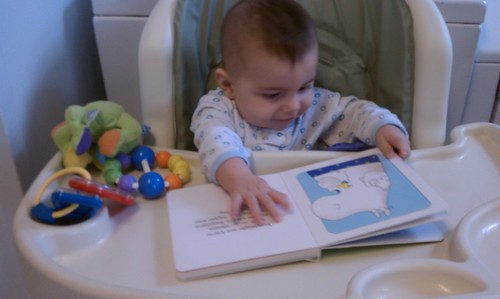
My grandson, "reading" at 6 months old:


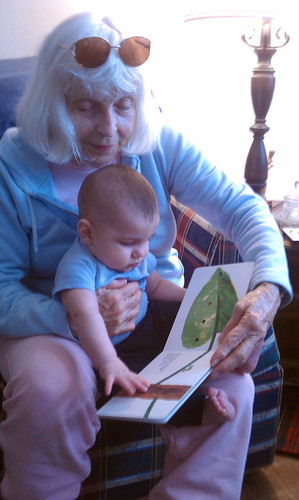
My mom and my grandson reading together:


*"The ACM  Conference on Human Factors in Computing Systems is the premier international conference of human-computer interaction. CHI 2011 focuses on leveraging our diversity and connecting people, cultures, technologies, experiences, and ideas."


Cross-posted on the TechPsych blog.

Apr 17, 2010

TellTable: Collaborative Creative Storytelling on a Multi-touch Table, from Microsoft Research, UK.

The TellTable is a collaborative digital storytelling application designed for Microsoft's Surface interactive multi-user multi-touch table. It was used by children in a school library in the UK, and was quite successful. The video below provides an overview about the way the TellTable worked. I think every school library/media center should have something like this!


"TellTable, a system developed in the Soci-Digital Systems group, uses Microsoft Surface technology to provide an interactive storytelling experience, similar to how children would tell stories using physical toys. Children can create various digital characters and sceneries on Surface, made out of photos taken of real world objects and environments as well as finger paintings. By manipulating these characters using multi-touch gestures, children can narrate, act and record imaginative stories together, before sharing them with friends later on.
TellTable was deployed in a primary school, and received overwhelmingly positive feedback. It has seen crowds of kids create stories featuring characters as diverse as Ninja chickens and rampaging teddy bears. Teachers were also enthusiastic about the potential of TellTable as an education tool, to help children develop communication skills and to create interactive tutorials when teaching foreign languages." -- Microsoft Research UK


Publications

Xiang Cao, Siân E. Lindley, John Helmes, Abigail Sellen. (2010). Telling the whole story: Anticipation, inspiration and reputation in a field deployment of TellTable. Proceedings of CSCW 2010, ACM Conference on Computer Supported Cooperative Work. p. 251-260.

John Helmes, Xiang Cao, Siân E. Lindley, Abigail Sellen. (2009). Developing the story: Designing an interactive storytelling application. Proceedings of ITS 2009, ACM International Conference on Interactive Tabletops and Surfaces. p.49-52.

Jan 30, 2010

The Importance of Storytelling and Multimedia Content (UPDATED)

Storytelling has been an important part of human culture for centuries and remains important, even thought it has been transformed by advances in technology.

It is transforming how young children think, communicate, and learn.

The following video from the University of Southern California's Institute for Multimedia Literacy (IML). In October of 2009, the Corporation for Public Broadcasting released a report that said that four and five year old children who had access to media tools had increased literacy levels as they entered kindergarten. A group of four-year-old preschool students were provided the opportunity to participate in the IML's workshop, Digital Storytelling and Recombinant Narrative, a workshop that is usually geared for adults.  Of course, the workshop was revised to meet the needs of a much younger group.

Here is the clip:

Digital Storytelling With 4-year-olds from IML @ USC on Vimeo.

Summative Evaluation of the Ready to Learn Initiative 
"The study, which was conducted by researchers at the Education Development Center, Inc. and SRI International, evaluated educational video content and associated interactive games from Super Why!, Between the Lions and Sesame Street, which are produced as part of the Ready To Learn (RTL) initiative. RTL aims to increase literacy skills for children aged 2-8 living in high poverty communities, by utilizing multiplatform content"

"The researchers examined the impact of the curriculum which included public media content in a randomized controlled trial with 398 low-income four and five-year olds from 80 preschool classes in New York City and San Francisco. The children who had public media content in their classes developed significantly more early literacy skills -- the ability to name letters, know the sounds associated with those letters and understand the basic concepts about stories and printed words -- than children who did not have public media content in the classroom."


Below is a collection of articles and links about issues related to storytelling in our digital age, from various perspectives.  The game is changing for everyone, especially for traditional teachers and journalists.

Better User Experience With Storytelling, Part One
Francisco Inchauste, Smashing Magazine, 1/29/10    (also read the comments to the article)


The Art of Storytelling
Christian Saylor, O'Reilly InsideRIA 3/23/09

Transmedia Storytelling and Entertainment - A Syllabus
Henry Jenkins, 8/11/09 
 Henry Jenkins is the Provost's Professor of Communication, Journalism, and Cinematic Arts at the University of Southern California. He arrived at USC in Fall 2009 after spending the past decade as the Director of the MIT Comparative Media Studies Program and the Peter de Florez Professor of Humanities. 

Henry Jenkin's syllabus includes the reading list for his class at USC of the same name, aong with great links to on-line publications related to the course. If you are pressed for time, take a look at Transmedia Storytelling 101.

Here is a link to a post I wrote in 2008 that provides a few good links related to storytelling:
Digital Storytelling, Multimodal Writing, Multiliteracies 

RELATED

Video from USC's Institute for Multimedia Literacy:


IML: Background and Philosophy from IML @ USC on Vimeo.

The Center for Digital Storytelling  


Multiliteracies

Interactive Narratives

Innovative Interactivity's Top 50 Multimedia Sites of 2009

USC Institute for Multimedia Literacy

Knight Digital Media Center Presentations  Example: Old Journalists in New Media:  Collaborating with Writers


O'Reilly Digital Media Blogs

Nov 11, 2007

Cross Post: Children of the Code

I came across the Children of the Code website today and thought I'd share it- if you are familiar with Children of the Code project, please leave a comment, since I haven't yet explored the entire site.

Childrenof thecode.org is an on-line multi-media resource that is part of a public/social education project to that aims to spread information and education about "The Code and the Challenge of Learning to Read it"

The project has four main components:
  1. A three hour Public Television, DVD and Web documentary series;
  2. A ten-hour college, university, and professional development DVD series;
  3. A series of teacher and parent presentations and seminars;
  4. A cross-indexed website/database containing audio, video and transcripts with the world's leading experts in fields related to reading.
The website includes over 100 interviews of people from a wide range of disciplines who are committed to promotion of health, education, and well-being of children, youth, and in turn, communities and society.

Here is the project's abstract:

"Abstract: Our children's cognitive and emotional development, self-esteem, academic, and later social and economic success, all depend on how well they learn - on the health of their learning. Whether we are involved in parenting, teaching, cognitive science, psychology, pedagogy, curriculum design, instructional design, direct instruction, constructivism, assessment, multiple intelligences, learning styles, learning differences, learning disabilities, learning theory, learning communities, organizational learning, preschool, elementary school, middle school, high school, home school, unschooling, college, university... we all share the responsibility of stewarding the health of our children's learning."


I'd recommend starting with the on-line video tour of the project:
http://www.childrenofthecode.org/Tour/index.htm

The following is a quote from an interview with David Boulton, the director of the Children of the Code project:

"The mission of the Children of the Code project is to catalyze and resource a transformation in how our society thinks about the "code" of our written language and the "challenges involved in learning to read it.". I think we're living in the "Stone Age of Literacy." Our lack of understanding of what is involved and what is at stake in acquiring literacy is wreaking havoc on the lives of our population, including children"

"..the first think I hope i that it (the project) changes the mental lens through which parents and teachers see struggling learners. I want them to see someone who is struggling as somebody who is struggling with an artificially confusing technology (written language) and somebody who is in significant emotional and cognitive danger.

"What I hope is that people realize that if children and adults struggle too long with the process of acquiring literacy, it can seriously affect how they develop and grow and learn. Struggling to read causes many, many people to grow up feeling ashamed of their mind.."

Links to the list of some of the interviews of "name" researchers and educators are posted on the TechPsych blog, or you can visit the site's interview list.

Jun 22, 2007

Visual and Multimedia Literacy: 500 Years of Women Art


Here is an example of the importance of visual and multimedia literacy, I thought I'd share this YouTube video clip of paintings of women's faces as they morph from one to another, depicting the last 500 years of art. In just under three minutes, the viewer gets a deeper understanding of the concept.

Jun 17, 2006

Interactive literacy applications and on-line resources

Here are some literacy links:

STARFALL
This extensive, free resource works well with in situations such as peer-tutoring, small group instruction, and home learning interventions. Good potential for reading intervention research, also for interventions/support for ELL students. Impressive on an interactive whiteboard. From the website: "“Starfall's online reading programs, together with Starfall's printed materials, are available free from our website as a public service. The website is easy to access and does not require special software to operate. Our printed materials are available for download free of charge. Starfall's educational objectives are consistent with the findings of National Research Council in their report on Preventing Reading Difficulties in Young Children."

EDUTOPIA ARTICLE ABOUT AUDIOBOOKS- "Listening to Literature"

EDUTOPIA ARTICLE ABOUT TECHNOLOGY AND READING - "Tech Teaches"


LEXIA LEARNINGSYSTEMS
Lexia provides interactive software applications for reading. A Spanish version is available. The Lexia Cross-Trainer provides interactive games to develop visual-spatial problem -solving skills. For more information, visit the Lexia products link and the support library.


"HeadSprout's secure, web-based performance reports summarize the online instruction into practical information for teachers and administrators. Automated performance reports provide objective, empirical information about each student's individual strengths and weaknesses and progression within the Headsprout reading program."
Edmark and Riverdeep offer a range of educational applications geared towards special learning needs. Some of the validity research regarding these products is dated. (Research that compares the effectiveness of these products with other interactive reading and academic programs is needed.)

LITERACY RESOURCES FOR SPECIAL NEEDS

Resources from UConn to support reading and writing for students with special needs.

NORTH CENTRAL REGIONAL LIBRARY ARTICLE ON TECHNOLOGY AND LITERACY - "
Critical Issue: Using Technology to Enhance Literacy Instruction

READ PRINT
Good resources for reading materials. Includes biographical information about various authors. According to the website: "Our website offers thousands of free books for students, teachers, and the classic enthusiast."

VCOM3D INC

From the website: "This technology provides interactive, 3D animated characters that communicate through body language (including gesture, signs, and facial expression), lip-synched speech, and action. Their embedded behaviors reflect each character‚’s individual personality, and makes them appealing and lifelike."

"A striking increase in attention span, their level of engagement, and results. During an evaluation at the Florida School for the Deaf and Blind, the increase in comprehension when shifting from text-only to text accompanied by sign language using SigningAvatar technology was 17% to 67%."


INTERVENTION CENTRAL

A great on-line resource is Intervention Central, created by Jim Wright, a school psychologist and school administrator. On this site, you will find several on-line tools, downloads, and links to a variety of academic and behavioral intervention strategies. Many of the interventions focus on literacy. There are some technology links on the site.

Update 3/24/10:  READ 180

"READ 180 is a comprehensive reading intervention program proven to meet the needs of struggling readers in transitional Grades 3–12. The program directly addresses individual needs through differentiated instruction, adaptive and instructional software, high-interest literature and non-fiction, and direct instruction in reading, writing, and vocabulary skills."