Showing posts with label stanford. Show all posts

Jun 13, 2013

Stanford's "Coding Together: Developing Apps for iPhone and iPad" Course Video Presentations on iTunesU

Now that the school year has ended, I've taken the first step to begin my "Summer of Code".  I have five weeks off each summer, and for me, it is the best time to brush up on my coding skills.   Since my school recently piloted an iPad program, I've developed an urge to learn Objective-C.  

So on the very first day of my summer break, I noticed in an email from Apple that that all of the presentation videos from Coding Together: Developing Apps for iPhone and iPad were made available, for free, though iTunes U. The course was designed for people who have some programming courses/experience, and from what I can see, provides a relatively "quick" and useful path for those who'd like to create an app for the iPhone or iPad.

After viewing the first video,  I am happy to say that I'm impressed with the way the professor, Paul Hegarty, explains it all.  


Course Description
"Updated for iOS 6. Tools and APIs required to build applications for the iPhone and iPad platform using the iOS SDK. User interface designs for mobile devices and unique user interactions using multi-touch technologies. Object-oriented design using model-view-controller paradigm, memory management, Objective-C programming language. Other topics include: object-oriented database API, animation, multi-threading and performance considerations. Prerequisites: C language and programming experience at the level of 106B (Programming Abstractions) or X. Recommended: UNIX, object-oriented programming, graphical toolkits."  -iTunesU Website

RELATED
iTunes U links to all course materials, including videos
Coding Together: Developing Apps for iOS Videos and Lecture Slides (iTunesU)
Website with files for course-related code
StackOverflow CS193P tagged items (Stack Overflow is an online resources for people with coding Q & As)

Feb 21, 2013

CCRMA Summer Workshops:Stanford's Center for Computer Research in Music and Acoustics

I would love to take a few summer workshops at Stanford's Center for Computer Research in Music and Acoustics, CCRMA.  I took a computer music technology class back in 2003 and have longed for more. 

Here is the schedule of workshops at CCRMA, from the CCRMA website:

6/17 - 6/21   Network Sound and Data:  Juan Pablo Caceres and Carr Wilkerson
6/24 - 6/28  Intelligent Audio Systems: Foundations and Applications of Music Information Retrieval:  Jay LeBoeuf, Leigh Smith, Steve Tjoa
7/8 - 7/12      Aspects of Sound in Art: Elaine Buckholtz and Sasha Leitman
7/15 -  7/19   SuperCollider: Fernando Lopez Lezcano and Bruno Ruviaro
7/22 - 7/26    The World of Auditory and Music Perception: Takako Fujioka, Poppy Crum, Pierre Divenyi
7/29 - 8/2      Music and Mobile Computing:  Mark Cerqueira and Spencer Salazar 
8/12 - 8/16    New Music Controllers: Edgar Berdahl and Michael Gurevich
8/19 - 8/23    Stompbox Design: Edgar Berdahl and Esteban Maestre
8/26 - 8/30    3D Printing for Acoustics :  John Granzow , Marlo Kohn, Scott Summit 
9/9 - 9/13      Perceptual Audio Coding:  Marina Bosi and Rich Goldberg


Tuition is $450.00 for each workshop. More information can be found on the CCRMA site.


If you happen to be interested, CCRMA offers undergraduate and graduate university degrees.   In addition to traditional courses, such as "Musical Acoustics" and "Seminar in Music Perception", other courses are offered, such as "Future Media/Media Archaeology", "Interactive Sound Art", and "Neuroplasticity and Musical Gaming".

I'd be just as happy with a visit to IRCAM, the Institute for Research and Coordination in Acoustics and Music in France.

Feb 20, 2013

AirHarp for Leap Motion, a Responsive Musical Natural User Interface

I like this demonstration of Adam Somers  AirHarp music application for use with the Leap Motion 3D controller:


AirHarp is being developed in C++ using Adam Somer's audio processing toolkit, MusKit.  This looks interesting!  Things have changes since I last took a computer music technology course (back in 2003).

Adam Somers is a senior software engineer at Universal Audio.  He has a graduate degree in music technology from Stanford, and a background in computer science, electronics, human-computer interaction, and signal processing.

Leap Motion is a motion-control software and hardware start-up company located in San Francisco, California. According to promotional information from the website, the company's first product, the Leap Motion controller, is 200 times more sensitive than existing technologies.  It will be interesting to see how this plays out.  (I'm still waiting for my pre-order.)

RELATED
AirHarp (links to GitHub)
Leap FAQs
Leap Motion Website
Leap Motion Developer Portal
Leap Motion Leadership Team
Leap Motion goes retail: Motion controller sold exclusively at Best Buy
Michael Gorman, engadget, 1/16/13

Leap Motion: Low Cost Gesture Control for your Computer Display
Asus partners up with Leap Motion, PCs with 3D motion control to debut in 2013
Michael Gorman, engadget, 1/3/13
Stanford Center for Computer Research in Music and Acoustics


Jul 16, 2012

Updated: SEPTRIS, A Game to Teach about Sepsis, plus related links, in memory of Rory Staunton

Earlier this year I wrote a post about SEPTRIS, a game developed to teach medical professionals about sepsis.  I have updated the post in memory of Rory Staunton, a 12-year-old boy who died on April 1st after a small scrape on his leg became infected with Group A Strep. Rory took a turn for the worse, as his infection became a sepsis crisis.  Some of his symptoms went unnoticed when he was in the ER and he was sent home.  By the time he returned, it was too late. 


Rory's death was featured in a recent article in the New York Times, resulting in comments from over 1500 people at the time of this post. After reading through some of the comments, it was clear to me that much more work needs to be done in terms of research, public awareness, and the  the continuing education of our medical professionals, so that more lives can be saved. Sepsis shock can occur from a variety of infections and is not limited to Strep. It is a complex issue. (Information regarding Rory's story can be found at the end of this post.)


Below is my updated post:

According to a fact sheet from the Global Sepsis Alliance, sepsis "remains the primary cause of death from infection despite advances in modern medicine, including vaccines, antibiotics, and intensive care.  Sepsis, which is often misunderstood by the public as "blood-poisoning", is one of the leading cause of death around the world.  Sepsis arises when the body's response to an infection injures its own tissues and organs.  It may lead to shock, multiple organ failure, and death, especially if not recognized early and treated promptly.  Between on third and one half of patients with sepsis die...

...Rapid initiation of simple, timely interventions, including antimicrobials and intravenous fluids can halve the risk of dying. Patients with suspected sepsis should be referred immediately to an appropriate facility...Unfortunately, sepsis is still mostly overlooked and recognized too late"


SEPTRIS, a game about sepsis, was developed by a team of people from Stanford University.   The following article, written by Sara Wykes (Stanford School of Medicine), provides an in-depth account of the story behind the development of a game designed to teach medical professionals about sepsis:  Game on: Stanford develops new tool for teaching doctors to treat sepsis. 
Renee Reijo Pera
Credit:  "Dr. Septris"; Septris Screen Shot: Stanford University


RELATED
Septris CME Website (Stanford)
Septris Game
Septris Technical Design & Development Team
Brian TobinJamie Tsui, James Laird, Glenn Zephier

World Sepsis Declaration (pdf)
Sepsis Alliance
Global Sepsis Alliance
Pediatric Sepsis Initiative
STOP Sepsis Collaborative
Presentation:  Preventing Sepsis: Artificial Intelligence, Knowledge Discovery, and Visualization (Phillip Chang, Remco Chang,Judy Goldsmith) 


Sepsis: Emergency

SEPSIS Rap


Why is this important?
Sepsis Awareness is now one of my "causes", because my daughter is a sepsis survivor, and too many other deaths could be prevented.  The first World Sepsis Day is September 13, 2012 and to do my part for the cause, I plan to share information about this serious global health concern.


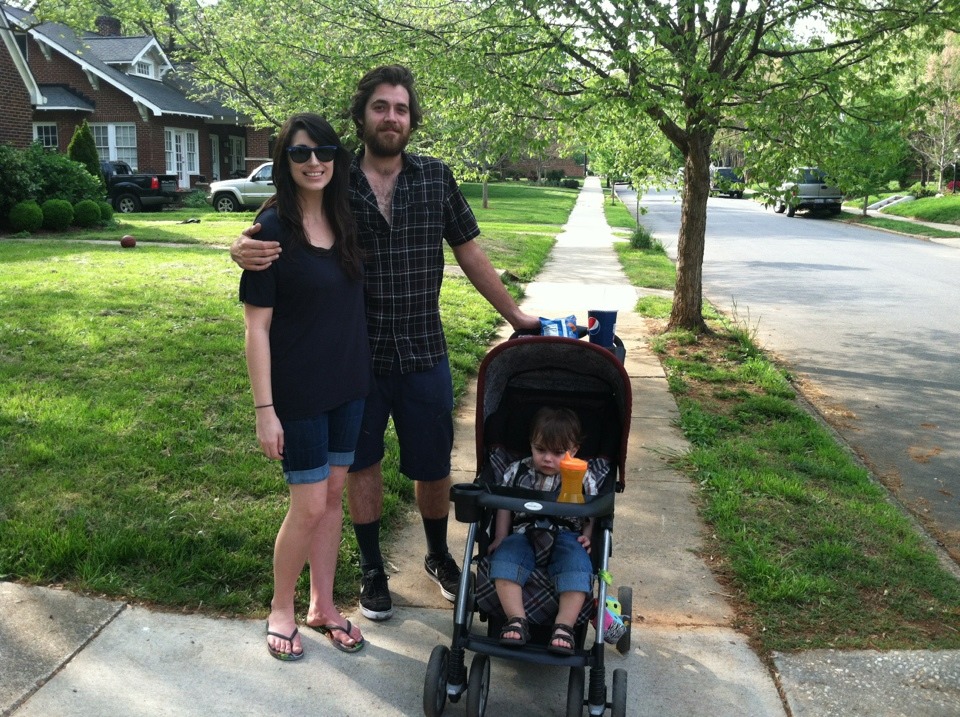
Below is a picture of my 24-year-old daughter, her husband, and son on Friday, March 30, 2012.   At the time this picture was taken, she felt fine and had just walked about a mile and a half or so on a family stroll. She was in perfect health.  She woke up in the wee hours of March 31st with the signs of an infection, took something for her aches and pains, and went back to bed.


The next morning, things were much worse. She didn't know it at the time, but her blood pressure was falling and the signs of sepsis were appearing.  Time was wasted going to an urgent care clinic. Fortunately, she was referred to the E.R, where her her symptoms were identified.  She received excellent treatment at Matthews Presbyterian Hospital.  It took several days until she was stable, and she was hospitalized for one week.  Unlike many people who experience sepsis, she did not suffer tissue damage or shutdown of her organs. Her treatment was initiated early enough to prevent this from happening. Although she survived, she suffered a great deal.

Below is a picture of my daughter as she was beginning to recover.
 
UPDATE 7/15/12  
My daughter is doing much better, but she experienced a great deal of fatigue for several weeks following her hospitalization. She's now 25, and happy to be alive.

RORY STAUNTON
I recently came across an article written in the New York Times, by Jim Dwyer, about Rory Staunton, a 12-year-old boy who died from a strep infection that resulted in a sepsis crisis that went untreated.  Unlike my daughter, Rory was discharged from the ER instead of being admitted for the intensive treatment that my daughter received. When his parents took him back to the hospital, it was too late. He died on April 1, 2012.  My daughter was battling sepsis in a hospital in North Carolina on the very same day. 


My heart goes out to Rory's family.  I know that he must have suffered a great deal.  

Although I am not a physician, I am sure that Rory's death could have been prevented, based on information in the article as well as information shared by Rory's parents on their website. To learn more about Rory's story, read the New York Time's article and a few of the comments. At the time of this update, over 1500 comments were listed on the NYT's website.


An Infection, Unnoticed, Turns Unstoppable
Jim Dwyer, New York Times, 7/11/12
Reaction to Column About a Boy Who Died
Jim Dwyer, New York Times, 7/14/12
Rory Staunton (website created by Rory's parents)
Rory's sepsis crisis was the result of toxic shock from a Strep A infection.  Sepsis can also be the result of other types of infections. The main thing to know that  is that once sepsis sets in, the patient requires immediate and intensive treatment, guided by an infectious disease specialist.  

Oct 23, 2010

Journalism in the Age of Data, by Geoff McGhee "...how can traditional narratives be fused with sophisticated, interactive information displays?"

Geoff McGhee is a journalist who specializes in multimedia and information graphics. He currently works at the Bill Lane Center for the Amercan West at Stanford, where he previously spent a year as a John S. Knight Journalism Fellow at the university, studying data visualization.  


In the following video, Journalism in the Age of Data,  McGhee provides an interesting overview of the ways different disciplines are collaborating-and converging- to create visualizations that communicate data and information in effective and meaningful ways. The video is over 50 minutes long, but worth viewing. 


Info from McGhee's Vimeo site:
"Journalists are coping with the rising information flood by borrowing data visualisation techniques from computer scientists, researchers, and artists.  Some newsrooms are already beginning to retool their staffs and systems to prepare for a future in which data becomes a medium.  But how can traditional narratives be fused with sophisticated, interactive information displays? Watch the full version with annotations and links at datajournalism.stanford.edu "

Journalism in the Age of Data from Geoff McGhee on Vimeo.

Jan 24, 2009

Digital Storytelling Platforms and Multiple Perspectives: A look at the work of Jonathan Harris - Food for Thought for Interactive Timeline Design

I'm in the process of creating an interactive timeline, and as I revisited my links and bookmarks, I came across a link to a video of Jonathan Harris discussing his ideas regarding digital storytelling, overlapping threads, and multiple perspectives.

Jonathan explores real-life stories and celebrates the interconnections between events, ideas, feelings, and people. Linear narrative and linear time lines do not do justice to the richness and complexities of human experience
.


"Combining elements of computer science, anthropology, visual art and storytelling, Jonathan Harris designs systems to explore and explain the human world."


"Jonathan Harris is redefining the idea of what it means to tell a story. Take a ride through an arctic whale hunt and plunge headfirst into the feelings Harris finds running rampant in cyberspace as he describes what he calls “storytelling platforms.” "

Below are links to two story-telling platforms described in the presentations. The Whale Hunt is organized so that the user can explore the story through a variety of perspectives and interfaces, and at different points in time.

The first screenshot shows how the user can select one of the "cast" members to see how the story unfolds from that person's point of view.


"Every few minutes, the system searches the world's newly posted blog entries for occurrences of the phrases "I feel" and "I am feeling". When it finds such a phrase, it records the full sentence, up to the period, and identifies the "feeling" expressed in that sentence (e.g. sad, happy, depressed, etc.). Because blogs are structured in largely standard ways, the age, gender, and geographical location of the author can often be extracted and saved along with the sentence, as can the local weather conditions at the time the sentence was written. All of this information is saved...The result is a database of several million human feelings, increasing by 15,000 - 20,000 new feelings per day. Using a series of playful interfaces, the feelings can be searched and sorted across a number of demographic slices, offering responses to specific questions..."


Jonathan Harris also presented at the December 2007 EG Conference. The video and related information can be found on the TED website.

Jonathan Harris: The art of collecting stories


If you have some time on your hands, explore Jonathan's Universe project:

http://universe.daylife.com/common/statement-universe.gif
This photo depicts the nine stages of the Universe environment.

"Universe is a system that supports the exploration of personal mythology, allowing each of us to find our own constellations, based on our own interests and curiosities. Everyone's path through Universe is different, just as everyone's path through life is different. Using the metaphor of an interactive night sky, Universe presents an immersive environment for navigating the world's contemporary mythology, as found online in global news and information from Daylife. Universe opens with a color-shifting aurora borealis, at the center of which is a moon, and through which thousands of stars slowly move. Each star has a specific counterpart in the physical world — a news story, a quote, an image, a person, a company, a team, a place — and moving the cursor across the star field causes different stars to connect, forming constellations. Any constellation can be selected, making it the center of the universe, and sending everything else into its orbit."

Universe was created using Processing, which is an open-source software that is used by people from all sorts of disciplines to create interesting interactive information visualizations and more. The data used in Universe is from Daylife. For more information about Daylife, visit the Daylife Labs.

Sidenote:
Jonathan Harris collaborated with Sep Kamvar on the We Feel Fine project. Sep Kamvar teaches classes like "Social Software" and "Computational Methods in Data Mining" at Stanford University. Sep is part of the Stanford Human Computer Interaction (HCI) Group.

Stanford's HCI group's weekly seminars highlight a variety of interesting speakers. Current and previous talks are available via Stanford OnLine. You can link to current presentations and videos from the Human Computer Interaction Seminar website. If you are curious, past presentations/abstracts can be accessed on-line alphabetically or by date, going as far back as 1990.

Dan Saffer, author of Designing Gestural Interfaces, presented "Tap is the New Click" on January 23rd, 2009 at Stanford.  You can access the
video directly.

Pop! Tech PopCast

Jan 19, 2008

Stanford University's Humanities Lab; Metaverse U,

On-line interactive virtual worlds such as Second Life, as well as online 3D games have become increasingly popular among adults and teens. It isn't too surprising that virtual worlds and videogames are now topics of formal study at the graduate level!

Researchers from the Stanford Humanities Lab have been involved in some interesting work. For several years, they have been studying virtual worlds, participating in Second Life, documenting the of the history of video games, working towards archiving digital virtual worlds, and participating in variety of other trans-disciplinary projects.

The Stanford Humanities Lab will be hosting a two-day conference in February 2008 that focuses on the topic of virtual worlds:


"The proliferation of virtual worlds has garnered tremendous interest, both in the media and in academia. To explore the cultural, technological, legal, and economic issues surrounding virtual worlds, the Stanford Humanities Lab is excited to announce Metaverse U, a conference to be held on Saturday, February 16th and Sunday, February 17th, 2008. We invite you to participate in this unique event.

Metaverse U aims to challenge traditional conference models with more collaborative and inclusive opportunities for participants, both virtual and physical. To ensure that its impact extends well beyond the actual conference, video from Metaverse U will be streamed live to the web, free of charge. After the conference, these videos will be archived and become part of a global conversation on virtual worlds."


If you are interested in learning more about interactive multimedia, 3D virtual worlds, on-line communication and collaboration, and the broader issues surrounding this area, don't miss the opportunity to attend - in person or on the web.

FYI

Metaverse U People

Stanford Humanities Lab's History of Computer Games Collection