Showing posts with label computer music technology. Show all posts

Feb 21, 2013

CCRMA Summer Workshops:Stanford's Center for Computer Research in Music and Acoustics

I would love to take a few summer workshops at Stanford's Center for Computer Research in Music and Acoustics, CCRMA.  I took a computer music technology class back in 2003 and have longed for more. 

Here is the schedule of workshops at CCRMA, from the CCRMA website:

6/17 - 6/21   Network Sound and Data:  Juan Pablo Caceres and Carr Wilkerson
6/24 - 6/28  Intelligent Audio Systems: Foundations and Applications of Music Information Retrieval:  Jay LeBoeuf, Leigh Smith, Steve Tjoa
7/8 - 7/12      Aspects of Sound in Art: Elaine Buckholtz and Sasha Leitman
7/15 -  7/19   SuperCollider: Fernando Lopez Lezcano and Bruno Ruviaro
7/22 - 7/26    The World of Auditory and Music Perception: Takako Fujioka, Poppy Crum, Pierre Divenyi
7/29 - 8/2      Music and Mobile Computing:  Mark Cerqueira and Spencer Salazar 
8/12 - 8/16    New Music Controllers: Edgar Berdahl and Michael Gurevich
8/19 - 8/23    Stompbox Design: Edgar Berdahl and Esteban Maestre
8/26 - 8/30    3D Printing for Acoustics :  John Granzow , Marlo Kohn, Scott Summit 
9/9 - 9/13      Perceptual Audio Coding:  Marina Bosi and Rich Goldberg


Tuition is $450.00 for each workshop. More information can be found on the CCRMA site.


If you happen to be interested, CCRMA offers undergraduate and graduate university degrees.   In addition to traditional courses, such as "Musical Acoustics" and "Seminar in Music Perception", other courses are offered, such as "Future Media/Media Archaeology", "Interactive Sound Art", and "Neuroplasticity and Musical Gaming".

I'd be just as happy with a visit to IRCAM, the Institute for Research and Coordination in Acoustics and Music in France.

Dec 14, 2010

Short documentary of the story behind the Reactable, a tangible user interface for creating music. (Includes an interview of Joel Bonasera, of Charlotte's Discovery Place museum.)

The following video provides a look into the history of the Reactable,  from the initial paper prototypes to the present, including the Reactable Mobile application designed for the iPad, iPhone, and iPod touch.   The video includes interviews of Sergi Jorda and Gunter Geiger, members of the original team at Pompeu Fabra University (Barcelona) that created the Reactable.  The other team members are Martin Kaltenbrunner and Marcos Alonso.


FYI:  At about 2:34 in the video, Joel Bonasera briefly discusses the Reactable installation at Charlotte's Discovery Place museum. Joel is a project manager at Discovery Place.


RELATED
How the Reactable Works
John Fuller, howstuffworks
Music Technology Group, Pompeu Fabra University
Reactable Website
Reactable Concepts
Reactable History
Discovery Place
Interactive Technology in the Carolinas: Discovery Place Science Center
(Includes a short video clip I took of the Reactable at Discovery Place)

Dec 5, 2009

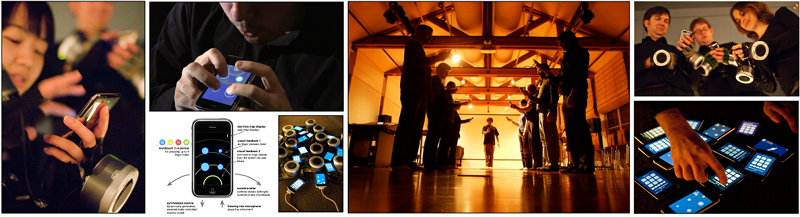
Social Music On-the-Go - Stanford Mobile Phone Orchestra; Ge Wang's SMULE apps for the iPhone

In the Charlotte Observer today, I came across an article about the Stanford Mobile Phone Orchestra- via the New York Times:

Musicians push edge of computer music with iPhone
Stanford orchestra turns popular songs into elaborate electronic renditions
I remembered that I'd posted about this previously nearly a year ago:  Play a flute by blowing on your iPhone!  In that post, I discussed an iPhone app by Smule called "Ocarina".  (If you follow the link to the post, you can view a video of some folks playing a version of Stairway to Heaven on their iPhones.)

Stanford Mobile Phone Orchestra (MoPhO)
Stanford MoPhO
A bit of background information:
Smule is company started by Ge Wang, an assistant professor of music at Stanford who is the director of the Stanford Mobile Phone Orchestra.  He also directs the Stanford Laptop Orchestra (SLOrk), and previously was involved with the Princeton Laptop Orchestra, known as PLOrk.  (Perry Cook, the author of Real Sound Synthesis for Interactive Applications, is one of the directors of PLOrk.)

Ge Wang's Ph.D. work was on ChucK, an audio programming language for "real-time synthesis, composition, performance, and analysis, supported on Mac0S X, Windows, and Linux.  To celebrate Ge Wang's thesis, Perry Cook wrote Everybody Hack ChucK Tonight (.mp3), to the tune of "Everybody Wang Chung Tonight".  The lyrics explain what the ChucK program is all about.

Ge Wang is teaching Mobile Music (Music, Computing, and Design II) at Stanford during the Spring 2010 semester. His department is affiliated with CCRMA, the Center for Computer Research in Music and Acoustics. (CCRMA offers non-credit week-long workshops each summer, open to the public. Maybe there will be a workshop on mobile music next summer!)

Enjoy the videos below:


Stanford Report, March 2009


Someone posted this on YouTube for the holidays last December:

Aug 14, 2009

What happens when engineers and musicians get together? They get Calvin Harris "Ready for the Weekend" with the Humanthesizer and Bare Ink

So what happens when engineers and musicians get a chance to mix it up?

The Humanthesizer project is the result of a collaboration between musician Calvin Harris, and masters students from the Royal College of Art Industrial Design Engineering program.
What makes this project innovative is that a special conductive ink, called Bare Ink, was used to support the creation of the music.

From the Bare Conductive website:

"
Bare is a conductive ink that is applied directly onto the skin allowing the creation of custom electronic circuitry. This innovative material allows users to interact with electronics through gesture, movement, and touch. Bare can be applied with a brush, stamp or spray and is non-toxic and temporary. Application areas include dance, music, computer interfaces, communication and medical devices. Bare is an intuitive and non-invasive technology which will allow users to bridge the gap between electronics and the body."

(Please overlook the bikini-clad women in the videos below, because the innovative technology supporting the Humanthesizer is worthy of the watch. Parents be forewarned!
)

The Making of the Humanthezizer


Close to the finished version:


Information from YouTube regarding the Humanthesizer project:


"Calvin performs a version of his new single Ready For The Weekend on a unique human synthesiser. The instrument employs 15 bikini clad models painted with Bare Conductive, a new skin safe ink which conducts electricity. When the performers touch the connection completes a circuit, triggering a sound....The instrument consists of 34 pads on the floor which have been painted with the conductive ink and connected to a computer via some clever custom electronics. The performers stand on the pads, and touch hands to complete a circuit and trigger a sound. Different combinations of pads trigger the different sounds needed to play the track....Bare Conductive was developed by RCA students Bibi Nelson, Becky Pilditch, Isabel Lizardi and Matt Johnson. The custom electronics and software for the project were created by Matt Johnson, employing two Arduinos and the graphical audio programming tool Max MSP. The performers, floor pads, Arduinos and Max MSP combine to create a giant MIDI controller which is used to create music which is sequenced and quantized with Ableton Live." (Special thanks to: RCA / Bare Conductive - Bibi Nelson, Becky Pilditch, Isabel Lizardi, Matt Johnson - http://www.bareconductive.com)
http://www.bareconductive.com/images/ink.jpg

(The Ready for the Weekend music video is available on YouTube. Parents: the music video has dancing girls throughout, in one-piece bathing suits.)

http://www.bareconductive.com/images/harris1_0.jpg


Thanks to Celine Latulipe for the link!

Jul 26, 2009

Multi-Touch Musical Instruments- Surface Editor: Post via the NUI-Group Forum

Home Page Image
Multi-touch Everywhere Technology in Action

Below is the video from
Future Instruments, a company formed through Geneva's Conservatory of Music and the University of Applied Sciences Western Switzerland. It is worth watching the entire video clip.

The following information was posted in the NUI-Group Forum:

"The research group at Geneva’s Conservatory of Music presents the Surface Editor and Surface Tracker software applications for turning ordinary surfaces into multi-touch musical instruments. The Surface Editor allows users to custom design interfaces by dragging and dropping components, such as buttons, sliders, keyboards, and many others, onto the interface. The surface can then be used to control digital audio workstations, virtual instruments, hardware synthesizers and samplers, VJ software, and other applications, via either the MIDI or OSC protocol. The Surface Tracker is a multi-touch tracking application created for tracking movements on a surface using high speed infrared OptiTrack cameras. These cameras have on-board image processing, which allows them to process 100 frames/sec while sparing the host computer’s CPU. The applications are available at
http://www.surface-editor.com."

Here are more details from the Future Instruments website:

Surface Tracker

"The Surface Tracker is an open source application for low latency multi-touch finger tracking. It was designed initially for our Multi-Touch Everywhere system (MUTE), but it should work more generally as well to track fingers which have been illuminated using the laser light plane method. It only supports low latency OptiTrack cameras; these cameras have frame rates of 100 frames per second, but due to their onboard image processing, these cameras only consume 3-5% of your computer's CPU (depending on your processor)."

"The Surface Tracker is a standalone application, which sends Open Sound Control messages to any connected client application at a user defineable IP address and port. It implements the TUIO protocol, which was specially designed for transmitting multi-touch events on a table surface."

"The Surface Tracker is currently only available on Windows. This is due to the fact that the driver for OptiTrack camera's is currently only available on Windows. We are, however, currently having discussions with the makers of the OptiTrack camera about extending support of their cameras to OS-X
."

You can download the Surface Tracker from the Future Instruments download page.

I wish this system was around when I was taking a computer music technology class!

RELATED
Greg Kellum's Website: Surface Editor

A Flexible Mapping Editor for Multi-touch Musical Instruments(pdf)
Greg Kellum, Alain Crevosier (9th International Conference for New Interfaces for Musical Expression - NIMES

Sneak Peek: Musical Instruments of the Future
Eliot Van Buskirk, Gadget Lab, Wired 2/25/09