Showing posts with label architecture. Show all posts

Nov 11, 2011

Revisiting Good Blogs: Space and Culture

Take a look at the Space and Culture  journal/weblog. Below are links to a few posts:
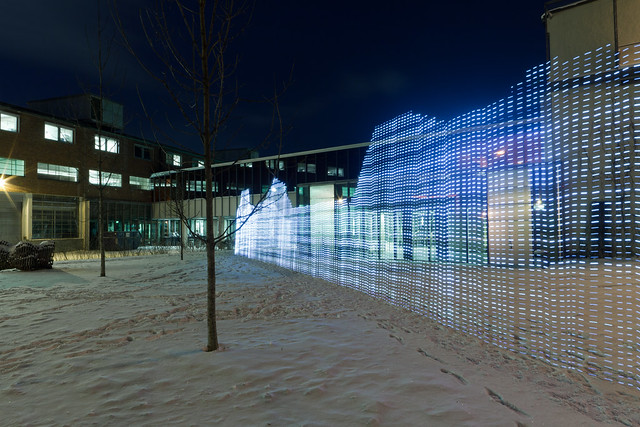
Wifi measuring rods thanks to Oslo School of Architecture (click on image for their article)
WiFi Measuring Rods, Oslo School of Architecture
Making WiFi Visible - Network City
Robert Shields, 10/6/11
Note: The above post provides a link to Making 'Immaterials: Light painting WiFi', a post written by Einar Sneve Martinussen the YOUrban blog. YOUrban is a research project at the Institute of Design within the Oslo School of Architecture and Design.


Sound, Space and the City
Catherine Scheelar, 10/10/11


Sound, Space, and the City:  Civic Performance in Downtown Los Angeles
"In Sound, Space, and the City, Marina Peterson explores the processes-from urban renewal to the performance of ethnicity and the experiences of audiences--through which civic space is created at music performances in downtown Los Angeles."


Mapping Flickr Photos and Twitter Tweets
Rob Shields, 7/20/11


RELATED/SOMEWHAT RELATED
Cognitive Cities Conference
Adam Greenfield's Presentation


I've cross-posted this to The World is my Interactive Interface blog - a blog I wish I had time to keep up!

May 3, 2011

TEDTalk: Carlo Ratti, of MIT's SENSEable City Lab - Flying Pixels-Helicopters, Sensors, Actuators, 3D Reconstruction of Movement, an Interactive "Cloud", and more

If you are interested in new interactive technologies, take 15 minutes to watch Carlo Ratti's TEDTalk about the work of MIT's SENSEable City lab:

Carlo Ratti is the director of the MIT SENSEable City Lab. He's a civil engineer and architect interested in sensors, hand-held electronics and the built environments of cities, and how data generated by sensors can be used to create new interactive, artistic environments.


In this March 2011 TED Talk, Ratti discusses how data from passive data sets, such as phone calls, can be harnessed to create visualizations that represent the life and interactions that take place in cities.  These visualizations are made interactive through the use of sensors and human gestures.


RELATED
SENSEABLE Website
Below are some examples of projects of the SENSEable City Lab:
Flyfire "...the Flyfire project sets out to explore the capabilities of this display system by using a large number of self-organizing micro helicopters.  Each helicopter contains small LEDs and acts as a smart pixel.  Through precisely controlled movements, the helicopters perform elaborate and synchronized motions and form an elastic display surface for any desired scenario...The Flyfire canvas can transform itself from one shape to another or morph a two-dimensional photographic image into an articulated shape...." -info from the Flyfire website
The Cloud (+atmos page)


"The CLOUD proposes an entirely new form of observation deck, connecting visitors for both the whole of London and the whole of the world, immersing them in euphoric gusts of weather and digital data.  Each individual footstep on the ascent to the CLOUD participates in a vast collective energy-harvesting effort.  Everyone around the world can contribute to the Cloud-whether by visiting or by sponsoring and LED, helping to keep the London lamp aflame." The CLOUD website
Real Time Rome
Trash|Track
Digital Water Pavillion

Oct 31, 2009

Locative & Mobile Media and Martijn de Waal's The Mobile City blog

I subscribe to Martijn de Waal's blog, The Mobile City:  Locative & Mobile Media/Urban Culture/Identity, partly because of my interest in ubiquitous/pervasive computing (specifically how technology can support interaction and collaboration between people across screens of all sizes in public spaces), and partly because I am interested in looking at the ways different disciplines adopt, adapt, and transform emerging interactive technologies.

If you are interested, take a look at my recent post about Martijn de Waal and topics related to locative/mobile media on The World Is My Interface blog.

Oct 19, 2009

Chris O'Shea's Hand from Above Interactive Screen; Info about Interactive Architecture

A recent post on the Interactive Architecture blog was of artist Chris O'Shea's "Hand from Above" project, a joint co-commission between FACT (Foundation for Art & Creative Technology), Liverpool City Council for BBC Big Screen Liverpool, and the Live Sites Network.  The installation premiered during the Abandon Normal Devices Festival.


Hand from Above from Chris O'Shea on Vimeo. (Written using openFrameworks & openCV. Sounds by Owen Lloyd.)

"Just imagine walking through your town or city centre, watching yourself on the Big Screen, when all of a sudden a giant finger appears and starts to play with you!...Hand From Above encourages us to question our normal routine when we often find ourselves rushing from one destination to another. Inspired by Land of the Giants and Goliath, we are reminded of mythical stories by mischievously unleashing a giant hand from the BBC Big Screen. Passers by will be playfully transformed. What if humans weren’t on top of the food chain? Unsuspecting pedestrians will be tickled, stretched, flicked or removed entirely in real-time by a giant deity"

For more information about Interactive Architecture and related topics read the following post:


Interactive Architecture and Transdisciplinary Convergence...
(The World Is My Interface blog)

Aug 7, 2009

Touch Screens and Interactive Displays Biz News, Part III: Transforming the Kiosk Concept

Kiosks have been around for a while, but with the increase interest in anything "touch", it looks like business is going well. As you can see from the pictures below, there has been a push to innovate the design and function of the utilitarian kiosks we've come to love (or hate) over the years:


As you can see, kiosks are multiplying and finding homes in all sorts of places. One example is TouchMate's SchoolDefender kiosk, designed for K-12 settings:


"TouchMate’s SchoolDefender is an interactive touch-screen kiosk system designed for use by K-12 schools to implement Visitor Management policies. After the visitor registers, the kiosk provides a stick-on badge that shows his name and picture, what areas of the school he may visit and when the badge expires."

You can even read the ne
ws on a touch-screen kiosk. Forget about newspapers or your Kindle!


And here is a pest management kiosk:


Here are some kiosks featured at IBM e-business centers, created by Imaginary Forces in collaboration with Design Office:


Note: Design Office is now known as Jason King Associates, as George Yu, Jason King's partner, passed away, sadly, at a young age. George Yu was highly regarded as a pioneer in the field of digital architecture.

"On his own, and in partnership with Jason King, Yu completed more than 65 projects, many of them for companies involved in new media and innovative design technologies. This felicitous pairing of clients and architect meant that each could learn from and teach the other. For example, in a trio of “e-business centers” for IBM, located in Chicago, New York City, and Atlanta, Yu and King—whose firm was called Design Office—designed a conference table that used projected images and interactive technologies developed by IBM. In a more recent project, the Honda Advanced Design Studio in Pasadena, California, Yu borrowed an innovative fabrication technology from the automotive industry and used it to create a sensuously curved interior wall."