Showing posts with label social networking. Show all posts
Showing posts with label social networking. Show all posts
Aug 5, 2011


Aug 4, 2011
Serendipity: Screen shot of two Google+ back-to-back posts about "circles".
Thinking about circles....

LINKS:
Crop circles: http://news.bbc.co.uk/2/hi/asia-pacific/8118257.stm
Complex circles, decision-making, expectations, plausible deniability:
http://albrecht-schmidt.blogspot.com
I plan to share my thoughts on G+ circles in a future post.
Jul 27, 2011
Link to Innovative Interactivity's List: "Thirty multimedia people to follow on Google+"
Tracy Boyer Clark, founding manager and editor of Innovative Interactivity, recently posted a nicely curated list of interesting people to follow on Google+.
Thirty multimedia people to follow on Google+
Tracy is a fantastic resource for all things related to multimedia. Be sure to add her to the list. BTW, my Google+ Multimedia circle includes everyone on Tracy's list, and a few more.
Thanks, Tracy, for sharing this list!
Thirty multimedia people to follow on Google+
Tracy is a fantastic resource for all things related to multimedia. Be sure to add her to the list. BTW, my Google+ Multimedia circle includes everyone on Tracy's list, and a few more.
Thanks, Tracy, for sharing this list!
Jul 10, 2011
Link: "The Old Internet Neighborhoods" -Message Boards, Forums, Chat Rooms, RIP? +more
In skimming through my RSS feeds today, I noticed that that Google+ has generated quite a bit of reflection about the evolution/revolution of on-line communities over the past week or so. In the article below, Virginia Heffernan reminisces about the days of the digital networking before the spread of broadband connections and Smartphones:
The Old Internet Neighborhoods
Virginia Heffernan, Opinionator, New York Times 7/10/11
Thanks to Bonnie Bracey Sutton for the link!
Here are some visual reflections related to Google+:

-Stephen Downes
 -Brooks Bayne

-Abid Shaikh
 -Abid Shaikh
SOMEWHAT RELATED
Beth Kantor, Beth's Blog: (How Networked Nonprofits Are Using Social Media to Power Change)
7/7/11
The Evolution of Cyberspace: Virtual Worlds
Craig Harm, Sendsonline.org, 1/22/11
Throwback to the 90's: How Social Networking is Moving Back to Private
Lydia Leavitt, The Next Web, 10/17/10
Google+Facebook Extension Integrates Facebook Viewing and Updating on Google+
David Galloway, Lifehacker, 7/9/11
Note: Apparently there was some problems with the extension, as mentioned in the update of the above article:"Update: We've learned that this browser extension has a lot of privacy violations and are retracting our recommendation of this extension. Please visit this Reddit post to find out detailed info on the problems and how to uninstall the extension from your system."
David Galloway linked the following article from his post:
Facebook blocks Google Chrome extension for exporting friends
Emil Protalinski, ZDNet, 7/5/11
The Old Internet Neighborhoods
Virginia Heffernan, Opinionator, New York Times 7/10/11
Thanks to Bonnie Bracey Sutton for the link!
Here are some visual reflections related to Google+:
-Stephen Downes
-Brooks Bayne
-Abid Shaikh
-Abid ShaikhSOMEWHAT RELATED
Keith Kleiner, Singularity Hub, 4/6/11
What is Your Plan for Google+ Experimentation and Exploration?Beth Kantor, Beth's Blog: (How Networked Nonprofits Are Using Social Media to Power Change)
7/7/11
The Evolution of Cyberspace: Virtual Worlds
Craig Harm, Sendsonline.org, 1/22/11
Throwback to the 90's: How Social Networking is Moving Back to Private
Lydia Leavitt, The Next Web, 10/17/10
Google+Facebook Extension Integrates Facebook Viewing and Updating on Google+
David Galloway, Lifehacker, 7/9/11
Note: Apparently there was some problems with the extension, as mentioned in the update of the above article:"Update: We've learned that this browser extension has a lot of privacy violations and are retracting our recommendation of this extension. Please visit this Reddit post to find out detailed info on the problems and how to uninstall the extension from your system."
David Galloway linked the following article from his post:
Facebook blocks Google Chrome extension for exporting friends
Emil Protalinski, ZDNet, 7/5/11
Jul 5, 2011
Interesting article about Google Plus and Social Tools for Schools (Audrey Watters, ReadWrite Web)
I've been invited to Google Plus, but can't play there yet until further notice. In the meantime, I'd like to share an interesting article about the potential for Google Plus for use in education settings:
Google Plus: Is This the Social Tool Schools Have Been Waiting For?
Audrey Watters, ReadWrite Web, 4/2/11)
Thanks to Stephanie Richardson for the link!
Google Plus: Is This the Social Tool Schools Have Been Waiting For?
Audrey Watters, ReadWrite Web, 4/2/11)
Thanks to Stephanie Richardson for the link!
Feb 22, 2011
How Social Can News Get? SoCon11 Presentation by Lee Rainie, Pew Internet Project
If you'd like to learn more about social media, take a look at the following presentation from the recent SoCon11 conference, "How social can news get?", by Lee Rainie, Director of the Pew Internet Project:
"Lee Rainie, Director of the Pew Internet Project, discusses the Project’s latest findings at the SoCon11 conference. He goes through trends in social media use in the last five years of the Project’s data. He explores how the turn to pervasive, participatory, personal, and portable news changes the way news consumers and producers behave and think about the role of news in their lives." - Pew Internet and American Life Project
Quite a few topics were covered at the conference, which can be found on the SoCon11 Agenda site.
"Lee Rainie, Director of the Pew Internet Project, discusses the Project’s latest findings at the SoCon11 conference. He goes through trends in social media use in the last five years of the Project’s data. He explores how the turn to pervasive, participatory, personal, and portable news changes the way news consumers and producers behave and think about the role of news in their lives." - Pew Internet and American Life Project
Quite a few topics were covered at the conference, which can be found on the SoCon11 Agenda site.
2011 2.5.11 - kennesaw -- social news
View more presentations from Lee Rainie.
SoCon11 Attendees
SoCon11 Speakers
View more presentations from Lee Rainie.
RELATED
SoCon11 Attendees
SoCon11 Speakers
Nov 8, 2010
RockMelt? Watch the video interview of the co-founders to learn more about the worlds newest web browser!
A quick glance at my morning newspaper- yes, the kind that involves paper and ink- brought to my attention that today is the first day that the RockMelt browser meets the world.
So what is special about RockMelt? According to the RockMelt blog, the browser is built on Chromium, the same source code that fuels Google's Chrome. The biggest investment in RockMelt was $10 million dollars, from Marc Andreessen's venture capital firm. Andreessen is also one of RockMelt's board of directors. RockMelt is tightly integrated with Facebook, which is understandable, since Marc Andreessen is also on that company's board of directors. (Marc Andreessen is the guy behind Netscape, one of the first popular browsers in the mid 1990's.)
Below is a video of an interview of the co-founders of RockMelt, who explain the reasons why browsers need to be re-invented to address social networking, "the cloud", and more.
"Wherever you go on the Internet, RockMelt makes the Web a personal experience. Because RockMelt is the first browser you log into, it unlocks your Web experience with your Facebook friends, your feeds, your favorite services, even your bookmarks and preferences. RockMelt is also the first browser to be fully backed by the cloud. This means you can access your personal browsing experience from anywhere, and you get quick updates from the people and sites that are important to you." -RockMelt Blog
Promo Video: RockMelt- Your Browser. Re-Imagined
For more information, visit the RockMelt website. You can also sign up to get the browser at the website. The browser might be a little buggy, as it is a Beta version, and is still in development.
So what is special about RockMelt? According to the RockMelt blog, the browser is built on Chromium, the same source code that fuels Google's Chrome. The biggest investment in RockMelt was $10 million dollars, from Marc Andreessen's venture capital firm. Andreessen is also one of RockMelt's board of directors. RockMelt is tightly integrated with Facebook, which is understandable, since Marc Andreessen is also on that company's board of directors. (Marc Andreessen is the guy behind Netscape, one of the first popular browsers in the mid 1990's.)
Below is a video of an interview of the co-founders of RockMelt, who explain the reasons why browsers need to be re-invented to address social networking, "the cloud", and more.
"Wherever you go on the Internet, RockMelt makes the Web a personal experience. Because RockMelt is the first browser you log into, it unlocks your Web experience with your Facebook friends, your feeds, your favorite services, even your bookmarks and preferences. RockMelt is also the first browser to be fully backed by the cloud. This means you can access your personal browsing experience from anywhere, and you get quick updates from the people and sites that are important to you." -RockMelt Blog
Promo Video: RockMelt- Your Browser. Re-Imagined
For more information, visit the RockMelt website. You can also sign up to get the browser at the website. The browser might be a little buggy, as it is a Beta version, and is still in development.
Jul 2, 2010
Kathy Sierra's Awesome Words of Wisdom: Video from Business of Software (in a 2.0-3.0 world)
Is your product, service, or company awesome in the eyes of your beholders? Do you help foster "self-awesomeness" among your users, customers, readers, or audience?
RELATED
Kathy Sierra is involved with theCreating Passionate Users website, where the bloggers "are all facinated by brains, minds and what science can tell us about the practice of making users passionate about their lives and tools. She is one of the co-creators of the Head First books from O'Reilly. I first learned about Kathy Sierra when I was taking a Java programming class on-line, and needed more resources. She created the JavaRanch website,"a friendly place for Java greenhorns"
By the way, the Head First books are great resources for people who are tech-curious and have an urge to learn to code. I love Head First books and have several on my reference shelves.
Thanks to Lukas Mathis for the link.
"...People are not into your tool, they are into what the tool enables." - Kathy Sierra
"Make them smarter." - Kathy Sierra
Business of Software website
Head First Bloggers' Reading List
The wisdom of a social media consultant won't sustain core innovation. In this video, Kathy Sierra talks about how to reverse engineer sustainable passion. What superpowers do you give your users? Watch the video to learn about a model that helps people get better.
The video is about an hour, but worth your time:
RELATED
Kathy Sierra is involved with theCreating Passionate Users website, where the bloggers "are all facinated by brains, minds and what science can tell us about the practice of making users passionate about their lives and tools. She is one of the co-creators of the Head First books from O'Reilly. I first learned about Kathy Sierra when I was taking a Java programming class on-line, and needed more resources. She created the JavaRanch website,"a friendly place for Java greenhorns"
By the way, the Head First books are great resources for people who are tech-curious and have an urge to learn to code. I love Head First books and have several on my reference shelves.
Thanks to Lukas Mathis for the link.
"...People are not into your tool, they are into what the tool enables." - Kathy Sierra
"Make them smarter." - Kathy Sierra
Business of Software website
Head First Bloggers' Reading List
May 8, 2010
Facebook and Privacy Issues: Reflections about the ever-changing interfaces of Facebook and the growing number of Facebook-connected websites.....
I joined Facebook in 2007 when I was taking a graduate HCI-oriented course about privacy and security. Heather Lipford, the professor, and some of my classmates were working on a study about Facebook and privacy, so I agreed to participate as a subject. What I quickly learned is that even graduate IT students can be puzzled about Facebook privacy settings. Facebook has made numerous changes to the way it handles privacy settings, and this has fueled research on this topic for the past few years (see links below).
Too many "regular" folks are unknowingly sharing things they do not want to share with the world, and it is difficult for most of us, including myself, to keep up with these rapid changes. For example, last month I came across a video of Mark Zuckerburg (founder of Facebook), announcing Open Graph which is a way of making "connected, mapped web that is more "social, personalized, smarter, and semantically aware." Zuckerburg's keynote presentation at the f8 conference was delivered on April 21st, yet on the day I posted about it, only a handful of people had viewed the video.
As of this post, only about 731 people had viewed the presentation, yet the key points that were reviewed will impact how the information we provide Facebook is used, stored, and perhaps shared by third-party web-based applications. With over 400,000,000 people on Facebook, this is an open invitation for those "in the know" to manipulate things in a way that many of us may not understand.
In the video below, Zuckerburg mentions that Facebook's policy for applications integrated with Facebook prohibited the storage or caching of data and information from the user for more than 24 hours. The rationale for the rule was to protect the privacy of Facebook users.
 At about 4:58 in the video, Zuckerburg discusses this policy, and announces that it has been changed. He then goes on to say, "We're going ahead and getting rid of this policy." (5:09) This made the audience very happy (about 5:10):

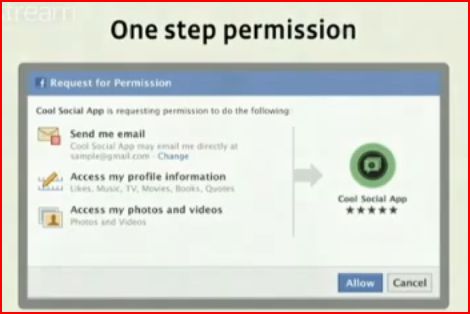
Zucherburg introduces the "One Step Permission" feature that provides third-party websites a simple means for users who have Facebook accounts to connect with the site. The hitch is that the user can't move forward and access what they'd like to access on the site unless they make the quick decision to give up quite a bit of their Facebook information. This will now give the host application use of your information, which they now can store ...forever, I assume.
Here is a screenshot of the single permissions dialog from the video at about 4:16:

Zucherburg's words:
"Now, if a person comes to your site, and gives you permission to access their information, you can store it. That means no more having to make the same API calls day after day. No more having to build different code paths just to handle information that Facebook users are (unwittingly?) sharing with you. We think that this step is going to make building with Facebook platform a lot simpler."
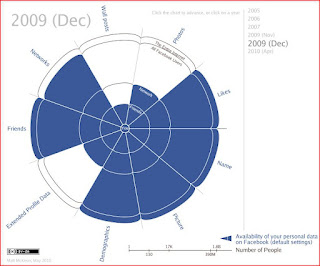
I knew there was a BIG problem with Facebook's privacy settings when Nathan Yau, author of the Flowing Data blog, tweeted about his discovery of information that Facebook somehow shared without his knowledge. Nathan's recent post, "Evolution of Facebook Privacy Policies", contains a interesting visualization, created by Matt McKeon of the Visual Communication Lab at IBM, that provides an interesting look at Facebook's privacy policies from 2005 on.
The Evolution of Privacy on Facebook (Interactive graphic with options for viewing an animation or an image-based version.)
The blue area represents the default settings regarding the availability of your personal data. As you can see, the default settings allow a large set of personal information to be shared among your Facebook connections as well as the outside world. As a member of Facebook, you must manually change your settings to make sure you have your preferred level of privacy. Don't assume this is taken care of for you by the application!



RELATED
Privacy bog causes Facebook to disable chat
Caroline McCarthy, CNET News 5/7/10
Video: Major Facebook Security Hole Lets You View Your Friends' Live Chats
Steve O'Hear, TechCrunch 5/5/2010
Nathan Yau and Flowing Data
f8 2010 Breakout Session Videos
Previous Post: Mark Zuckerburg's Recent Keynote at f8: Facebook's OpenGraph
Lipford, H. R., Besmer, A., and Watson, J. "Understanding Privacy Settings in Facebook with an Audience View." In the Proceedings of the USENIX Workshop on Usability,
Psychology, and Security (UPSEC 2008), April 14, 2008. pdf
Lipford, H.R., Hull,G. Latulipe, C., Besmer,A., Watson, J. Visible Flows: Contexual Integrity and the Design of Privacy Mechanisms in Online Social Networking. In Proceedings of the Workshop on Security & Privacy in Online Social Networking, August 2009. pdf
Lipford, H.R., Watson, J., Whitney, M., Froiland, K., and Reeder, R.W. "Visual vs. Compact: A Comparison of Privacy Policy Interfaces. In Proceedings of CHI'10. Atlanta, Georgia, USA. April 2010. pdf
Strater, K., and Lipford, H.R. "Strategies and Struggles with Privacy in an Online Social Networking Community". In the Proceedings HCI 2008, Liverpool, UK. 2008. pdf
Watson, J., Whitney, M., and Lipford, H.R. "Configuring Audience-Oriented Privacy Policies." In the Proceedings of the Workshop on Assurable and Usable Security Configuration, ACM CCS, November 2009. (abstract)
SOMEWHAT RELATED
IBM's Visual Communication Lab is behind the Many Eyes website, which I used as a resource during when I was taking a course in information visualization and visual communication. At the time, I was looking at data related to the high-school drop-out problem in the US. I loved how the on-line Many Eyes application provided me with a variety of ways of looking at the data I had collected for my team's project. Since then, thousands of other people have utilized the Many Eyes website. Warning: If you are interested in data, stats, and information visualization, be prepared to spend a while exploring. It is an enticing rabbit hole!
Many Eyes: For Shared Visualization and Discovery
Cross-posted on The World Is My Interface
Too many "regular" folks are unknowingly sharing things they do not want to share with the world, and it is difficult for most of us, including myself, to keep up with these rapid changes. For example, last month I came across a video of Mark Zuckerburg (founder of Facebook), announcing Open Graph which is a way of making "connected, mapped web that is more "social, personalized, smarter, and semantically aware." Zuckerburg's keynote presentation at the f8 conference was delivered on April 21st, yet on the day I posted about it, only a handful of people had viewed the video.
As of this post, only about 731 people had viewed the presentation, yet the key points that were reviewed will impact how the information we provide Facebook is used, stored, and perhaps shared by third-party web-based applications. With over 400,000,000 people on Facebook, this is an open invitation for those "in the know" to manipulate things in a way that many of us may not understand.
In the video below, Zuckerburg mentions that Facebook's policy for applications integrated with Facebook prohibited the storage or caching of data and information from the user for more than 24 hours. The rationale for the rule was to protect the privacy of Facebook users.


Zucherburg introduces the "One Step Permission" feature that provides third-party websites a simple means for users who have Facebook accounts to connect with the site. The hitch is that the user can't move forward and access what they'd like to access on the site unless they make the quick decision to give up quite a bit of their Facebook information. This will now give the host application use of your information, which they now can store ...forever, I assume.
Here is a screenshot of the single permissions dialog from the video at about 4:16:
Zucherburg's words:
"Now, if a person comes to your site, and gives you permission to access their information, you can store it. That means no more having to make the same API calls day after day. No more having to build different code paths just to handle information that Facebook users are (unwittingly?) sharing with you. We think that this step is going to make building with Facebook platform a lot simpler."
I knew there was a BIG problem with Facebook's privacy settings when Nathan Yau, author of the Flowing Data blog, tweeted about his discovery of information that Facebook somehow shared without his knowledge. Nathan's recent post, "Evolution of Facebook Privacy Policies", contains a interesting visualization, created by Matt McKeon of the Visual Communication Lab at IBM, that provides an interesting look at Facebook's privacy policies from 2005 on.
The Evolution of Privacy on Facebook (Interactive graphic with options for viewing an animation or an image-based version.)
The blue area represents the default settings regarding the availability of your personal data. As you can see, the default settings allow a large set of personal information to be shared among your Facebook connections as well as the outside world. As a member of Facebook, you must manually change your settings to make sure you have your preferred level of privacy. Don't assume this is taken care of for you by the application!


RELATED
Five Hidden Dangers of Facebook: Security Expert on Big Risks You Should Be Aware You're Taking When You Use the Site (CBS News.com 5/8/10)
"Your information is being shared with third parties Privacy settings revert to a less safe default mode after each redesign Facebook ads may contain malware Your real friends unknowingly make you vulnerable Scammers are creating fake profiles "
Privacy bog causes Facebook to disable chat
Caroline McCarthy, CNET News 5/7/10
Video: Major Facebook Security Hole Lets You View Your Friends' Live Chats
Steve O'Hear, TechCrunch 5/5/2010
Nathan Yau and Flowing Data
f8 2010 Breakout Session Videos
Previous Post: Mark Zuckerburg's Recent Keynote at f8: Facebook's OpenGraph
HCI Lab at UNC-Charlotte:
"At the Human Computer Interaction Lab (HCILab) at UNC Charlotte, we investigate novel ways for people to interact with computers, and through computers with their environments. Our research covers a broad range of areas within Human Computer Interaction, such as Novel Interaction and Multimedia, Privacy, Creativity, and Visual Analytics. We collaborate with researchers in a number of areas related to HCI, such as visualization, gaming, art, and psychology. We also study interaction in a variety of domains such as intelligent information systems, information privacy and security, image processing and graphics, and intelligence analysis."
UNC-C's HCI Facebook Research ArticlesLipford, H. R., Besmer, A., and Watson, J. "Understanding Privacy Settings in Facebook with an Audience View." In the Proceedings of the USENIX Workshop on Usability,
Psychology, and Security (UPSEC 2008), April 14, 2008. pdf
Lipford, H.R., Hull,G. Latulipe, C., Besmer,A., Watson, J. Visible Flows: Contexual Integrity and the Design of Privacy Mechanisms in Online Social Networking. In Proceedings of the Workshop on Security & Privacy in Online Social Networking, August 2009. pdf
Lipford, H.R., Watson, J., Whitney, M., Froiland, K., and Reeder, R.W. "Visual vs. Compact: A Comparison of Privacy Policy Interfaces. In Proceedings of CHI'10. Atlanta, Georgia, USA. April 2010. pdf
Strater, K., and Lipford, H.R. "Strategies and Struggles with Privacy in an Online Social Networking Community". In the Proceedings HCI 2008, Liverpool, UK. 2008. pdf
Watson, J., Whitney, M., and Lipford, H.R. "Configuring Audience-Oriented Privacy Policies." In the Proceedings of the Workshop on Assurable and Usable Security Configuration, ACM CCS, November 2009. (abstract)
SOMEWHAT RELATED
IBM's Visual Communication Lab is behind the Many Eyes website, which I used as a resource during when I was taking a course in information visualization and visual communication. At the time, I was looking at data related to the high-school drop-out problem in the US. I loved how the on-line Many Eyes application provided me with a variety of ways of looking at the data I had collected for my team's project. Since then, thousands of other people have utilized the Many Eyes website. Warning: If you are interested in data, stats, and information visualization, be prepared to spend a while exploring. It is an enticing rabbit hole!
Many Eyes: For Shared Visualization and Discovery
Cross-posted on The World Is My Interface
Feb 26, 2010
Web-based Technology-Supported Interaction: 6Rounds mixes webcam, games, and social media....
I've been so busy writing reports* that this almost passed me by!
I found out about 6rounds because they use Twitter as a promotional platform. I happened to notice that this company was following me and clicked on the link.
6rounds started out as an outgrowth of a speed dating website, and the application was initially designed for people to use while waiting for speed dating sessions. According to the 6rounds website FAQ's, "6rounds is a live meeting point, offering users a variety of experiences that they enjoy together using a combination of webcams, real-time games, social activities and media engagements."
Since I'm a happily married middle-aged woman, I'm not sure 6rounds is up my alley. I think social singles, college students, and others who don't mind flashing their faces through a webcam would like it.
If I had time, I might like to play around with GixOO, the opensource API that underpins 6rounds. GixOO has the potential for developers to develop games and activities. The application allows the users to track each other as they move their mice, and also enables people to see the same things as their friends as they interact online.
6rounds looks like it might provide possibilities for collaborative projects in education, but I won't be sure until I give it a try.
So what is 6rounds?
FOR THE TECH-CURIOUS
The following information was quoted from the Openomics blog from Sun Microsystem's ISV Engineering:
"6rounds is the first product built on the GixOO live social platform, initially developped on the LAMP stack. As a member of the Sun Startup Essentials program, GixOO connected with Sun's ISV Engineering team to test the scalability of their platform on SAMP --the Solaris-based AMP stack, available in an integrated and optimized package from Sun, the Sun Glassfish Web Stack f.k.a. CoolStack. At the time, we ran the benchmark on a Sun SPARC Enterprise T5120 server --featuring the 64-way CoolThreads processor UltraSPARC T2-- running Solaris 10 and CoolStack 1.3. GixOO loved the DTrace kernel instrumentation of Solaris 10 --DTrace gives unique insights into how the application performs, live on a production system-- and the Containers technology a.k.a. Zones --this light-weigth virtualization layer of Solaris allows multiple applications to run in isolation from each other on the same physical hardware--, and quickly adopted them for their internal use.
2/26/10: Oracle bought Sun in 2009. Here were the latest results when I did a search to get more information:

Not Really Related
*For those new to this blog, I'm a school psychologist who returned to her day job full time a year and 1/2 ago, when the economy was taking a nosedive. Before that, I was working part-time and taking computer and technology classes, initially to learn how to create interactive multimedia applications and games.
Since some of the kids and teens I work with have a range of abilities and disabilities, including autism, I developed an interest in accessibility. How can universal design principles be applied to games and emerging interactive technologies? I'm also fascinated by interactive displays and surfaces of all sizes, especially ubiquitous systems that support cognition, collaboration and communication.
One of my pet projects:
My vision? A collaborative multimedia, multi-modal interactive time-line might help us to understand complex, interrelated factors and events more effectively. It would provide an opportunity for the inquisitive to view things from a broad perspective, and also explore things in rich detail. Ideally, the time-line would support multi-touch, multi-user interaction on larger displays and interactive whiteboards, and allow for people who are remotely located to participate in the process.
Now that one of my schools will be getting a multi-touch SMARTTable, I'd like to experiment with time-line concepts and interactions on a table surface. I'd also like to figure out how this can work seamlessly with the existing SMARTBoard that is in the classroom. Of course, this would have to take place during after work hours!
I found out about 6rounds because they use Twitter as a promotional platform. I happened to notice that this company was following me and clicked on the link.
6rounds started out as an outgrowth of a speed dating website, and the application was initially designed for people to use while waiting for speed dating sessions. According to the 6rounds website FAQ's, "6rounds is a live meeting point, offering users a variety of experiences that they enjoy together using a combination of webcams, real-time games, social activities and media engagements."
Since I'm a happily married middle-aged woman, I'm not sure 6rounds is up my alley. I think social singles, college students, and others who don't mind flashing their faces through a webcam would like it.
If I had time, I might like to play around with GixOO, the opensource API that underpins 6rounds. GixOO has the potential for developers to develop games and activities. The application allows the users to track each other as they move their mice, and also enables people to see the same things as their friends as they interact online.
6rounds looks like it might provide possibilities for collaborative projects in education, but I won't be sure until I give it a try.
So what is 6rounds?
FOR THE TECH-CURIOUS
The following information was quoted from the Openomics blog from Sun Microsystem's ISV Engineering:
"6rounds is the first product built on the GixOO live social platform, initially developped on the LAMP stack. As a member of the Sun Startup Essentials program, GixOO connected with Sun's ISV Engineering team to test the scalability of their platform on SAMP --the Solaris-based AMP stack, available in an integrated and optimized package from Sun, the Sun Glassfish Web Stack f.k.a. CoolStack. At the time, we ran the benchmark on a Sun SPARC Enterprise T5120 server --featuring the 64-way CoolThreads processor UltraSPARC T2-- running Solaris 10 and CoolStack 1.3. GixOO loved the DTrace kernel instrumentation of Solaris 10 --DTrace gives unique insights into how the application performs, live on a production system-- and the Containers technology a.k.a. Zones --this light-weigth virtualization layer of Solaris allows multiple applications to run in isolation from each other on the same physical hardware--, and quickly adopted them for their internal use.
"At GixOO, we use Sun SPARC-based server, powered by Solaris 10 for our R&D environment. The system gives us the required flexibility and components isolation that we need. Thanks to SPARC's great SMP abilities, we achieve high performance for many development environments running on one single 1U server.Somewhat Related
Solaris Zones are very comfortable and simple to configure, and allow the full utilization of the great power hidden in this small machine, which makes Solaris 10 an excellent choice for system administrators. We are using Sun MySQL Server which gives our application high speed data storage solution, and in the future we might migrate to the MySQL Cluster solution to get even faster results."
Dmitry Shestak, CTO, GixOO"
2/26/10: Oracle bought Sun in 2009. Here were the latest results when I did a search to get more information:

Not Really Related
*For those new to this blog, I'm a school psychologist who returned to her day job full time a year and 1/2 ago, when the economy was taking a nosedive. Before that, I was working part-time and taking computer and technology classes, initially to learn how to create interactive multimedia applications and games.
Since some of the kids and teens I work with have a range of abilities and disabilities, including autism, I developed an interest in accessibility. How can universal design principles be applied to games and emerging interactive technologies? I'm also fascinated by interactive displays and surfaces of all sizes, especially ubiquitous systems that support cognition, collaboration and communication.
One of my pet projects:
My vision? A collaborative multimedia, multi-modal interactive time-line might help us to understand complex, interrelated factors and events more effectively. It would provide an opportunity for the inquisitive to view things from a broad perspective, and also explore things in rich detail. Ideally, the time-line would support multi-touch, multi-user interaction on larger displays and interactive whiteboards, and allow for people who are remotely located to participate in the process.
Now that one of my schools will be getting a multi-touch SMARTTable, I'd like to experiment with time-line concepts and interactions on a table surface. I'd also like to figure out how this can work seamlessly with the existing SMARTBoard that is in the classroom. Of course, this would have to take place during after work hours!
Jan 18, 2010
Facebook Settings and Privacy: Jeff Elder's post. "Walk through Facebook Privacy Settings". A must-read & do!
I use Facebook at least once a day to keep up with relatives, friends, colleagues, colleagues of colleagues, and interest groups. In many situations, I find that Facebook is much more efficient than relying on e-mail, Twitter, and RSS feeds. Sad to say, the frequent use of Facebook without regularly inspecting and modifying privacy settings (and other settings) will result in exposing parts of your life to the world, seeming without your informed consent.
One person I rely on for good advice regarding privacy issues and social networking sites is Jeff Elder. His recent blog post, "Walk through Facebook privacy settings" is something I recommend members of Facebook read read and follow. It might take up to 30 minutes of your time, but the time you spend will be important.
Through blogging, so much of "me" is out there, and this is the case for many others. Even so, it is important for me to have control over what Jeff Elder calls "the giant peephole". What people can see through the peephole of Facebook changes, often in the periphery of our awareness, and as a result, we might be sharing more information to others, including marketers, than we would like.
(Jeff Elder is a longtime Charlotte Observer columnist who studied social media on a Knight fellowship at Stanford University, blogs about social media and networking for folks in the Charlotte, NC region.)
One person I rely on for good advice regarding privacy issues and social networking sites is Jeff Elder. His recent blog post, "Walk through Facebook privacy settings" is something I recommend members of Facebook read read and follow. It might take up to 30 minutes of your time, but the time you spend will be important.
Through blogging, so much of "me" is out there, and this is the case for many others. Even so, it is important for me to have control over what Jeff Elder calls "the giant peephole". What people can see through the peephole of Facebook changes, often in the periphery of our awareness, and as a result, we might be sharing more information to others, including marketers, than we would like.
(Jeff Elder is a longtime Charlotte Observer columnist who studied social media on a Knight fellowship at Stanford University, blogs about social media and networking for folks in the Charlotte, NC region.)
Nov 18, 2009
The Social and Technological Innovations in Social Media: Video of recent panel presentations moderated by Henry Jenkins at the USC Annenberg School of Communication and Journalism
Times are changing faster than we can change the buzzwords that convey this change. Social Media. Spreadibility. Immersive Journalism.
Henry Jenkins, the Provost's Professor of Communication, Journalism, and Cinematic Arts at the University of Southern California, recently moderated a panel on the topic of social and technological innovations in social media. If you are in the mood for reflection, the videos below of the panel presentations are worth a look. Topics covered include on-line social networks, 3D virtual worlds, immersive journalism, social computing research, "stickiness moving to spreadable", and more.
If you are in a rush, the following article provides an overview of the panel discussions, along with key quotes from the various participants:
Annenberg panels explore "Social Media: Platform or Provocation for Innovation?
Lara Levin, Student Writer, USC Annenberg News 11/16/09
Session 1- Video Social Media: Platform or Provocation for Innovation?
Session 2 - Implicatons of Social Media for Business, Learning and Institutional Development
Description from the USC Annenberg YouTube Channel:
Nov. 5, 2009: "Implications of Social Media for Business, Learning and Institutional Development"
"As part of the week-long visit by and dialogue with Annenberg Innovator in Residence Dr. Irving Wladawsky-Berger, Dean Ernest J. Wilson III hosts a half-day conference titled "Social Media: Platform or Provocation for Innovation?" In this panel, "Implications of Social Media for Business, Learning and Institutional Development" experts from USC Annenberg and IBM will explore recent innovations and future trends in the social media space as well as industry responses to these developments. The rate of innovation in social media has been staggering in recent years. The result is a substantially different media landscape than one confronted by media organizations even five years ago. The conversation will focus on both the demands of the new media marketplace and the barriers that organizations are likely to face in attempting to meet these demands. In addition to Wladawsky-Berger, panelists include USC Annenberg faculty members Henry Jenkins, Jonathan Taplin, Dmitri Williams, Marc Cooper, executive in residence David Westphal and research fellow Nonny de la Peña. They will be joined by IBMs Steve Canepa, general manager for media and entertainment and Julia Grace, software engineer and Melissa Cefkin, ethnographer and research scientist."
Henry Jenkins, the Provost's Professor of Communication, Journalism, and Cinematic Arts at the University of Southern California, recently moderated a panel on the topic of social and technological innovations in social media. If you are in the mood for reflection, the videos below of the panel presentations are worth a look. Topics covered include on-line social networks, 3D virtual worlds, immersive journalism, social computing research, "stickiness moving to spreadable", and more.
If you are in a rush, the following article provides an overview of the panel discussions, along with key quotes from the various participants:
Annenberg panels explore "Social Media: Platform or Provocation for Innovation?
Lara Levin, Student Writer, USC Annenberg News 11/16/09
Session 1- Video Social Media: Platform or Provocation for Innovation?
Session 2 - Implicatons of Social Media for Business, Learning and Institutional Development
Description from the USC Annenberg YouTube Channel:
Nov. 5, 2009: "Implications of Social Media for Business, Learning and Institutional Development"
"As part of the week-long visit by and dialogue with Annenberg Innovator in Residence Dr. Irving Wladawsky-Berger, Dean Ernest J. Wilson III hosts a half-day conference titled "Social Media: Platform or Provocation for Innovation?" In this panel, "Implications of Social Media for Business, Learning and Institutional Development" experts from USC Annenberg and IBM will explore recent innovations and future trends in the social media space as well as industry responses to these developments. The rate of innovation in social media has been staggering in recent years. The result is a substantially different media landscape than one confronted by media organizations even five years ago. The conversation will focus on both the demands of the new media marketplace and the barriers that organizations are likely to face in attempting to meet these demands. In addition to Wladawsky-Berger, panelists include USC Annenberg faculty members Henry Jenkins, Jonathan Taplin, Dmitri Williams, Marc Cooper, executive in residence David Westphal and research fellow Nonny de la Peña. They will be joined by IBMs Steve Canepa, general manager for media and entertainment and Julia Grace, software engineer and Melissa Cefkin, ethnographer and research scientist."
Aug 7, 2009
Foursquare: Interactive Local + Social Media Coming to a City Near You.
Foursquare is a locative-mobile system/game/social media game/activity that is starting to grow in popularity in a number of urban settings, such as NYC. It hasn't arrived in Charlotte, so I can only share what I've gleaned about it from the Foursquare website and a few reviews:
"We're all about helping you find new ways to explore the city. We'll help you meet up with your friends and let you earn points and unlock badges for discovering new places, doing new things and meeting new people."
"It's foursquare! Think: 50% friend-finder, 30% social cityguide, 20% nightlife game. We wanted to build something that not only helps you keep up with your friends, but exposes you to new things in and challenges you to explore cities in different ways. There's a lot of experimenting here, so bear with us as we try to figure it all out (and thanks!)"
"We have an iPhone app, a mobile-web site (Blackberry! Treo!) and an SMS shortcode (50500) that you can text check-ins to. For more info, look here." (For more information, visit the Foursquare NYC website.)
RELATED:
Foursquare: Check In, Tweet....Money on Beer (Jennifer Van Grove, Mashable, 8/7/2009)
"Foursquare is poised to be a prime player in the location-based social networking space."
Forsquare: Why it May Be the Next Twitter (Jennifer Van Grove, Mashable, 7/25/2009)
"The Game: To those of you not playing, it may sound like a joke, but don’t knock it till you try it. You earn points for every check-in — unless of course you check-in at the same locale all the time. You’re rewarded with more points for being adventuresome (exploring different parts of the city), for hitting up multiple spots in one night, and eventually for the tips other people try and the to-dos you complete."
Screen-shot from Jennifer Van Grove's Foursquare App:

Building an Army of Hyper-Local, Mobile-Connected Advocates: Or, Why Marketers Should Pay Attention to Foursquare (Allison Mooney, Ad Age Digital, 8/5/09)
"Co-founder Dennis Crowley puts it this way: "I think Foursquare found some kind of sweet spot between the intersection of social utility (Hey, I know where my friends are), sharing/oversharing (I log everywhere I go/everything I do) and gaming/rewards (every check-in gives you a little piece of candy)."
Cities: Amsterdam, Atlanta,Austin, Boston, Chicago, Dallas/Ft. Worth, Denver, Detroit, Houston, Las Vegas, Los Angeles, Miami, Minneapolis/St. Paul, NYC, Philadelphia, Phoenix, Portland, San Diego, San Franscisco, Seattle, Washington D.C.
(Also posted on the Technology Supported Human-World Interaction blog.)
"We're all about helping you find new ways to explore the city. We'll help you meet up with your friends and let you earn points and unlock badges for discovering new places, doing new things and meeting new people."
"It's foursquare! Think: 50% friend-finder, 30% social cityguide, 20% nightlife game. We wanted to build something that not only helps you keep up with your friends, but exposes you to new things in and challenges you to explore cities in different ways. There's a lot of experimenting here, so bear with us as we try to figure it all out (and thanks!)"
"We have an iPhone app, a mobile-web site (Blackberry! Treo!) and an SMS shortcode (50500) that you can text check-ins to. For more info, look here." (For more information, visit the Foursquare NYC website.)
RELATED:
Foursquare: Check In, Tweet....Money on Beer (Jennifer Van Grove, Mashable, 8/7/2009)
"Foursquare is poised to be a prime player in the location-based social networking space."
Forsquare: Why it May Be the Next Twitter (Jennifer Van Grove, Mashable, 7/25/2009)
"The Game: To those of you not playing, it may sound like a joke, but don’t knock it till you try it. You earn points for every check-in — unless of course you check-in at the same locale all the time. You’re rewarded with more points for being adventuresome (exploring different parts of the city), for hitting up multiple spots in one night, and eventually for the tips other people try and the to-dos you complete."
Screen-shot from Jennifer Van Grove's Foursquare App:
Building an Army of Hyper-Local, Mobile-Connected Advocates: Or, Why Marketers Should Pay Attention to Foursquare (Allison Mooney, Ad Age Digital, 8/5/09)
"Co-founder Dennis Crowley puts it this way: "I think Foursquare found some kind of sweet spot between the intersection of social utility (Hey, I know where my friends are), sharing/oversharing (I log everywhere I go/everything I do) and gaming/rewards (every check-in gives you a little piece of candy)."
Foursquare is designed with these game dynamics in mind, and it's the absurd appeal of its reward that makes the service so "sticky.""
Naveen Selvadurai (Foursquare Co-Founder)Cities: Amsterdam, Atlanta,Austin, Boston, Chicago, Dallas/Ft. Worth, Denver, Detroit, Houston, Las Vegas, Los Angeles, Miami, Minneapolis/St. Paul, NYC, Philadelphia, Phoenix, Portland, San Diego, San Franscisco, Seattle, Washington D.C.
(Also posted on the Technology Supported Human-World Interaction blog.)
Jan 13, 2008
Link to TechPsych blog with links to edubloggers, information about Classroom 2.0, and more!
Take a look at my recent post on the TechPsych blog about edubloggers, Classroom 2.0, and more. You'll find some links to interesting blogs.
If you know of related blog you'd like me to add, please let me know.
If you know of related blog you'd like me to add, please let me know.
Nov 12, 2007
Cross Posted on TechPsych: Classroom 2.0 - Social Networking and Resources for Educators
Classroom 2.0 is a good resource for educators who would like to keep up with the fast pace of technology. If you work with digital natives, you know how difficult it can be to keep one step ahead of the game! Classroom 2.0 provides forums, Wikkis, and resources on a variety of topics and the content is maintained by members of the network, which at the last count was at 3998.
From the Classroom 2.0 website
"The social network for educators using collaborative technologies!"
"Welcome to Classroom20.com, the social networking site for those interested in Web 2.0 and collaborative technologies in education. We especially hope that those who are "beginners" will find this a supportive community and a comfortable place to start being part of the digital dialog. Feel free to explore!"
From the Classroom 2.0 website
"The social network for educators using collaborative technologies!"
"Welcome to Classroom20.com, the social networking site for those interested in Web 2.0 and collaborative technologies in education. We especially hope that those who are "beginners" will find this a supportive community and a comfortable place to start being part of the digital dialog. Feel free to explore!"
Feb 13, 2007
Imagini website "Visual DNA"
The Imagini.net website is a form of social networking that relies on pictures to develop each user's "visual DNA". It has an innovative method of using pictures to develop personality profiles. Each user's response is stored into a database is used to further develop the "visual dna" tool. This website is geared for networking and entertainment, not education, but it is has many features that could be used in other kinds of applications.
Subscribe to:
Posts (Atom)