Showing posts with label special needs surface. Show all posts

Dec 29, 2007

Keepon, BeatBot's robot: Potential to promote social behavior in children with autism spectrum and developmental disorders.

The BeatBots project develops rhythmically intelligent robots for research and entertainment. In the video below, the responsive robot, Keepon, dances to the Spoon song, "Don't You Evah".

Keepon was developed by Hideki Kozima and programmed by Marek Michalowski, from Carnegie Melon.


(The video is available to the public under the terms of the Creative Commons Attribution-NonCommercial 3.0 license.)


According to an article by David Templeton in the Pittsburgh Post-Gazette:

"While the videos have proven Keepon's human appeal, the double-bubble yellow fellow's key role is to interact with children. Keepon has shown promise in encouraging social behavior in children with developmental disorders, including autism."

"Keepon's simple appearance makes children comfortable, and its lifelike movement makes it attractive to them," Mr. Michalowski said. "This combination creates an environment in which social interaction is encouraged.""

"While the robot can dance to almost any song, it also can identify visual and other sensory rhythms, helping to prove how rhythm and synchronization in body language are paramount in human interaction. As such, Keepon has schooled roboticists in how to improve human interaction with robots."

An example of Keepon's attentive and emotive actions:


Another example of Keepon's entertainment value - Spoon's "I turn my camera on":


More videos can be found on the BeatBots website.

May 31, 2007

Microsoft Surface multi touch screen table - I wish I had one for my projects last semester!

Microsoft Research recently unveiled Microsoft Surface: http://microsoft.com/surface

This multi - touch table can be used for a variety of applications, as outlined in the video from CNET and YouTube below:


I'd like to work on applications for use on a touch-table to support students with special needs, especially those who have autism spectrum disorders.

Last semester, I worked on prototype applications for use on a touch-screen surface -here is a photo. We used a
NextWindow Human Touch large-screen display, which provided great screen resolution and touch-response.


This application was part of a travel-planning prototype developed for a course in Human-Computer Interaction. The application was demonstrated on a NextWindow Human Touch large screen display. Would it work on the iPhone?


Update: Examples from some of my other posts:


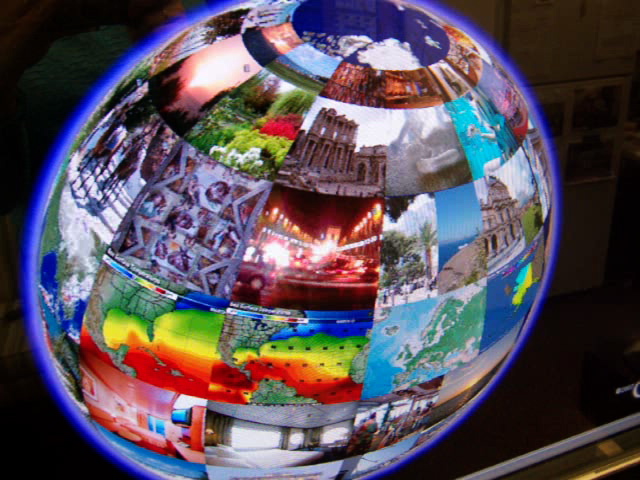
Here is another demo videoclip of a globe created in GoogleEarth using photo-overlays, with links to video clips uploaded to YouTube and embedded in individual posts on a blog. The above photo and the video clip show the application on a NextWindow Human Touch large-screen display.

This application would be great on a touch-table or touch-table set up on a drafting board. Although it was designed for a travel-planning application, it would work well in educational settings in subjects such as geography.


Poetry Picture Share


This was my first attempt at a "poetry picture share" application. It was designed for use on a multi-touch table and can be accessed remotely so people in different places can move things around on the screen. The video shows how the application works on a NextWindow Human Touch interactive large-screen display.

I am planning on adapting this application for use with students with special needs, such as those who have autism or other communication disorders.